Let me tell you a story.
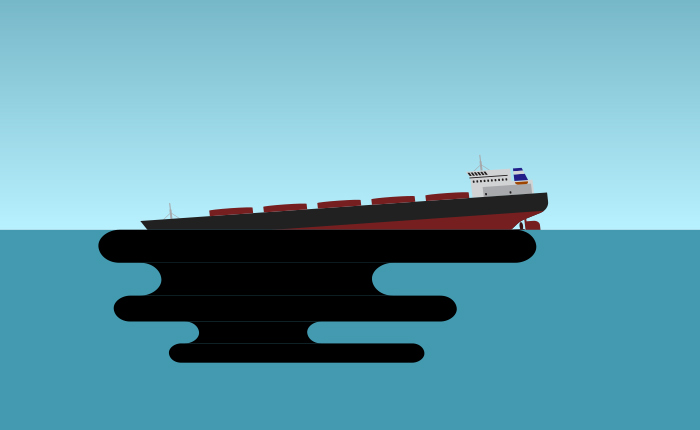
A ship loaded a cargo of crude oil from Mina-Al-Ahmadi and was bound for Wales. On the way, it got aground outside territorial waters of any country.
119000 T of crude oil spilled and found its way on the coastal waters of two countries, UK and France. Millions of Dollars were spent for clean up operation.
Apart from the money required for clean up operation, there were number of people who lost their source of income.
For example, fishermen could no more go for fishing. People who earn their living from tourism, were also hit by this incident.
Apart from all this there is damage to the ecology which no one can measure in monetary values.
Now who would pay for all these damages ?
Ship owners ? The incident did not take place in the territorial waters of any country. Even if it did take place, the local laws for these cases are never so detailed to easily recover the money from ship owners.
Now even if ship owner had to pay the money, the money may be so big that a ship owner could loose entire business because of one incident.
What is the solution then ? CLC convention aims to bring a solution to this situation.
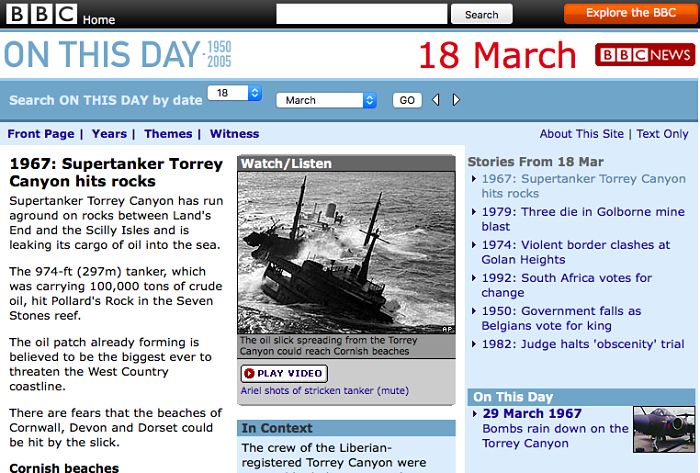
In fact the story I told you above is the real story of the vessel “Torrey Canyon”.
CLC convention was the result of the incident of grounding and oil pollution of the vessel “Torrey Canyon“.
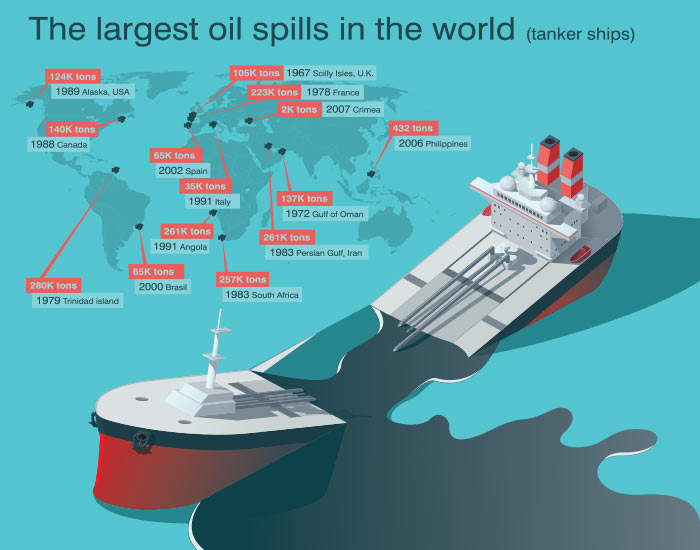
And there have been many incidents of oil pollution before and after Torrey Canyon.
Let us see how CLC convention is helping to solve the problem of paying for the damages and at the same time not burdening the ship owners.
CLC convention
CLC convention first came into existence in 1969 and was called CLC 69. This convention was later amended in 1992. CLC 92 was amended in the year 2000 to increase the amount of compensation. We will discuss the latest amended convention i.e. amended CLC 1992.
CLC is the short form for “International Convention on Civil Liability for Oil Pollution Damage”.
As the name suggests, it is the convention that determines the liability of the parties in case of oil pollution damages.
CLC convention can be summarised in four points
- Ship owner is liable for the oil spills originating from his ship
- There are very few exceptions to this liability to the ship owners in case of oil spills from their ships
- There is a maximum limit of liability set out in CLC according to the tonnage of the ship. This limit will not be applicable if owner is at fault
- It is compulsory for the ship owners to take insurance to cover his liability in case of oil pollution from his ships
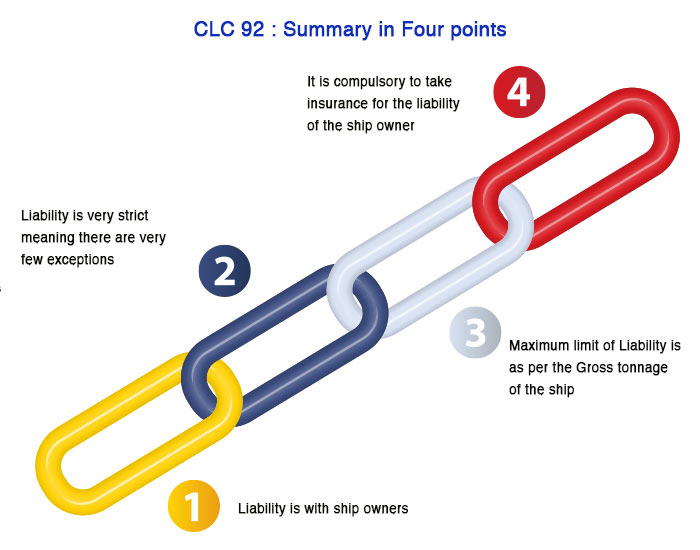
These four points summarises the whole CLC 92 convention in brief. Let us now discuss this convention in little detail.
1. When would CLC convention apply ?
The applicability of any convention is the most important thing. After all if a convention is not applicable in some situation then all other articles of the convention would not apply.
This is the reason that the article detailing the application of a convention is one of the initial article of any convention.
So let us see when and how CLC convention apply.
Type of oil
First thing we should know that CLC deals with oil pollution only. Which kind of oils ? It deals with pollutions from persistant oil only.
Persistent oils, as the name suggest are the one that persists longer in the environment. Whereas Non-persistent oils either evaporate easily or disperse easily.
The pollution from persistant oil is more serious when compared to non-persistant oils. Persistant oils require more resources and money for clean up operation.
So the CLC convention applies to the pollution of persistent oils.
For example in July 2011, an abandoned oil tanker was found an aground in Mumbai’s Juhu beach. The vessel was abandoned near to Oman. The ship had drifted and got aground in Mumbai’s Juhu beach.
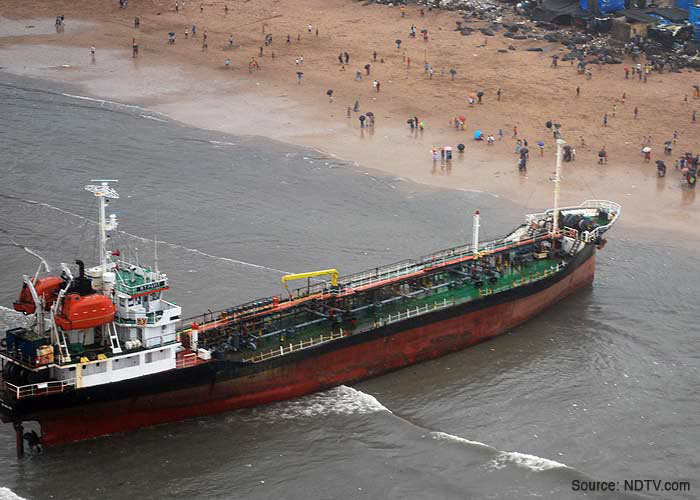
Indian authorities filed a claim of 1.8 Millions US dollars for the various works like towage and removal of oil.
The claim was rejected because the oil carried by the ship during previous voyage was MGO which is non-persistant oil.
Area of application
The area to which CLC convention would apply is covered under annex II of the convention. The CLC convention applies to any pollution incident that occurred either in the
- Territory and Territorial waters of a contracting state. In simple words territorials waters is the area of 12 NM rasius from the baseline of the contracting state.
- Exclusive economic zone (EEZ) of the contracting state. In simple words EEZ is the area of 200NM radius from the baseline of the contracting state.
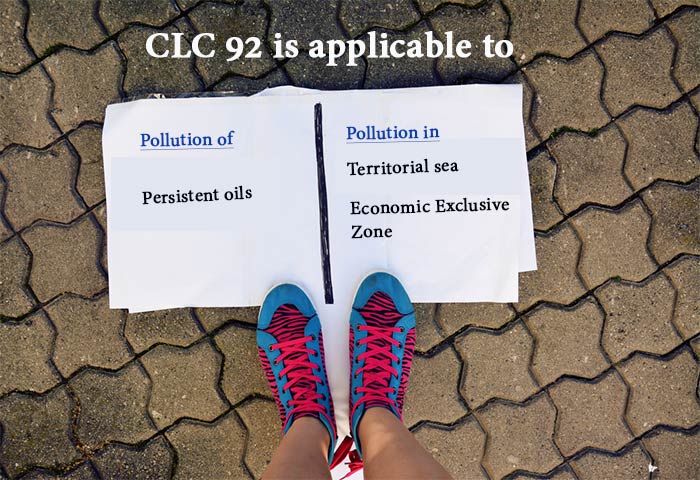
The CLC 92 does not cover the pollution incidents in the high seas. High seas pollutions were not included in the CLC convention because the pollution in high seas were considered to cause lesser damages.
Damages because of pollution incident
Even though the CLC convention deals with the pollution incidents, damage can be much more than the pollution itself.
The compensation and liability of the owner of the polluting ship does not limit to the pollution alone.
Damages include physical injury, psychological conditions and loss of income resulting from the pollution. CLC convention covers the expenses for all of these damages.
2. Who need to pay in case of pollution incident
Oil pollution incidents are costly affairs. It requires great amount of money to clean oil spills and somebody need to pay for it.
As I said, one of the principle of the CLC convention is that ship owner is liable for pollutions from their ships. And as such, in most of the cases it would be ship owner who need to pay for it.
In any case, as per article III, para 4, no claim can be made against
- the servants or agents of the owners or crew members. If you read the footer of the emails sent by the ship management employees, it would read “as agents to the owners only”. This is to stress upon the point that they are acting on behalf of owners as agents.
- pilot, charterers, a person performing salvage or a person taking preventive actions
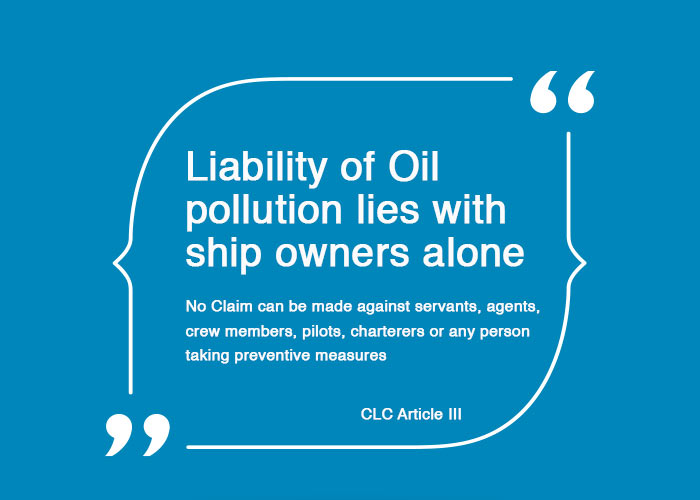
So it does not matter if the ship is on bareboat charter or is being handled by a ship management company, the claim can only be made against the owner of the ship.
3. How much ship owner need to pay in case of a pollution incident
Let us talk about the money part of the CLC convention. We can talk about the money part by talking about how much ship owner would pay in case of a pollution incident.
This can be covered in 3 situations
1. Ship owners need not pay anything if he proves that
- Pollution resulted from the act of war or natural phenomenon of exceptional, inevitable or irresistible nature. One example of natural phenomenon could include the pollution if a tanker gets aground because of tsunami.
- Pollution resulted because a third party delibrately wanted to cause the damage to the ship
- Pollution resulted because of negligence of government or other authority who failed to maintain the lights or other navigational aid.
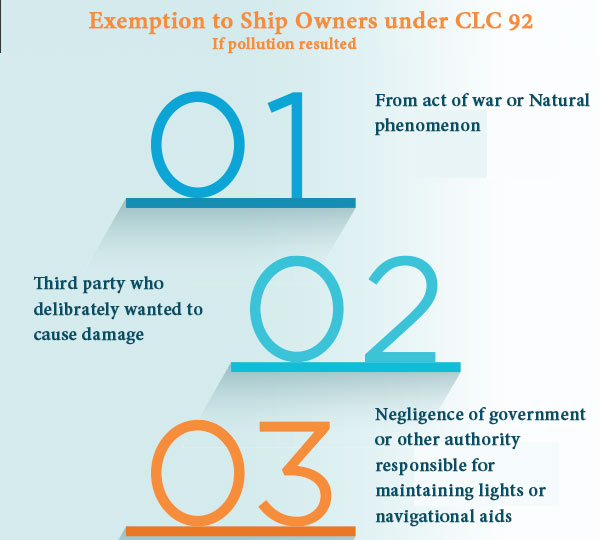
While the first point may not be difficult to prove, other two points are more difficult to prove. This means that ship owners have hardly any exception to the liability. In almost all the cases of oil pollution, ship owners need to pay the money.
2. Ship owner need to pay the full amount whatever damages are claimed by various claimants if it is proved that
- damages were the result of acts of ship owner committed with the intent to cause this damage
- damages were because of the acts of ship owners who knew that his acts would result in these damages
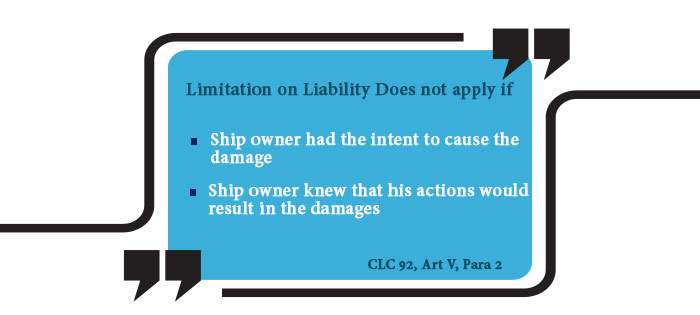
For example if the ship was trading with an expired trading certificate, ship owner would need to pay for the all the damages.
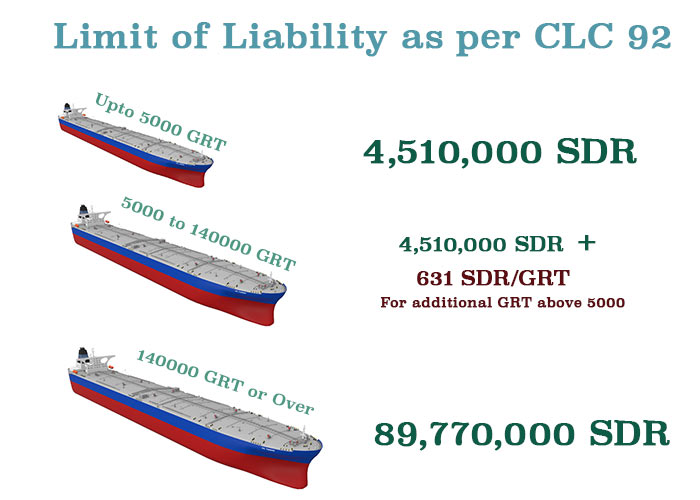
3. If a ship owner do not fall in above two categories, his liability in any one pollution incident would be limited to
- 4,510,000 SDR for vessels up to 5000 GRT
- For vessels over 5000 GRT, the maximum liability will be 4,510,000 SDR + 631 SDR per additional GRT above 5000 GRT. So for a vessel with 10000 GRT, maximum liability would be SDR 7,665,000 (4,510,000 + 631 x 5000)
- Maximum liability in any case will not be more than SDR 89,770,000
Question is why limit the liability of the ship owners ? For example if the vessel got aground because ship’s crew did not keep a good watch and damages are in billions, why owners is required to pay only fraction of it ?
The answer lies in the principle of shipping business. If there is no limit of liability on ship owner, they need to pay for more insurance. Because of this, they would charge more freight and thus oil price would be higher.
Limit on ship owner’s liability brings a balance between paying for the damages and not over-burdening the ship owners.
4. What a ship owner need to do to ensure that his ships are not arrested by the claimant
In the case of Torrey canyon incident, the claimant arrested a sister ship of the owners in Singapore. The ship could only be released upon payment of USD 3 millions to the claimants.
This was the times before the CLC convention.
But to take the advantage of CLC convention and to ensure that his ships are not arrested after a pollution incident, a ship owner need to constitute a fund equal to his liability as per CLC convention.
The idea here is that, after the investigation if ship owner is liable to pay the amount equal to his limit of liability, the claimant need not be chasing the ship owners for money.
The money should already be in the possession of the court.
The fund can be constituted by
- depositing the sum or
- producing the bank gauranttee or
- any other way acceptable to the contracting state where fund need to be constituted.
5. Where the action for compensation can be brought
Again in the case of Torrey Canyon, the pollution resulted in the territorial waters of UK and France. This could be very common situation in the present scenario too.
So where the action for compensation can be brought against the ship owner ?
As per article IX of CLC 92, action can be brought in any of the country that was affected by the pollution.
Article X also states that the judgment given by the court in which action is brought will have to be recognised by other states.
6. Insurance required as per CLC 92
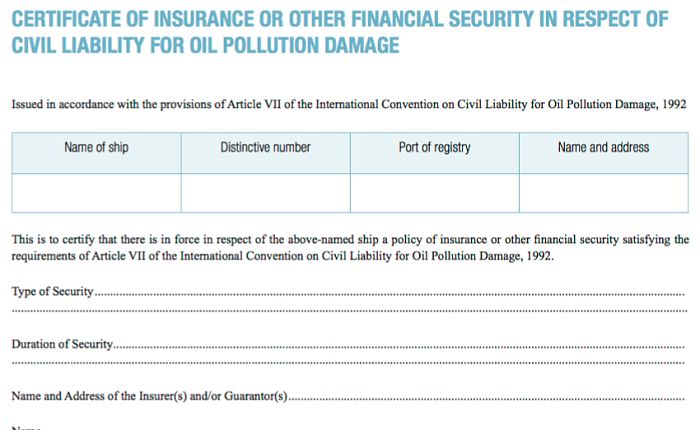
As per article VII of CLC 92, all ships that carry more than 2000 T of oil as cargo need to maintain insurance equal to the ship owner’s liability as per CLC 92.
This certificate is issued by the flag of the ship after the ship owner provides proof of the insurance to the flag.
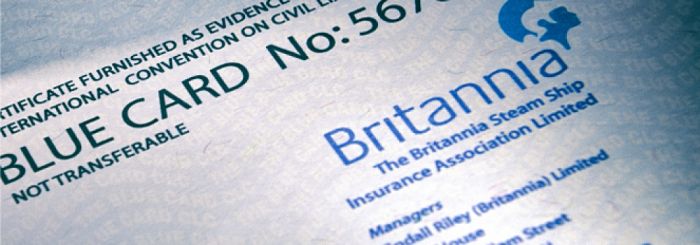
The insurance cover (proof of insurance) is called the blue card. This blue card need to be provided to the flag along with the application for issuance of this certificate.
The certificate is usually valid for the period of one year from 20th of February of each year.
The CLC certificate also plays one important benefit both for ship owners and the claimant. The claim for the pollution damage can be brought directly against the insurer or person providing the financial security.
Conclusion
Each year close to 11000 Billion ton-mile of oil is transported through sea. Even though oil spill incidents have reduced drastically in recent year, shipping industry need to be ready for all th eventualities.
CLC convention is one such step. It not only defines the liability in case of oil pollution incident but also limits this liability to encourage the oil trade.
The question you may ask is who would pay for the amount spent over and above the ship owner’s liability. This amount is paid under the Fund convention which I will cover in future post.