ISM code has been the most controversial among all the chapters of SOLAS. There are plenty of seafarers and shore staff who feel that ISM code has only brought more paper work and nothing else.
But a detailed report on the impact and effectiveness of the ISM code suggests that “where the ISM Code had been embraced as a positive step toward efficiency through a safety culture”, tangible positive benefits were evident.
But as you would note that the report has a caveat which is “Where the ISM code had been embraced as a positive step“.
How do we embrace ISM code as a positive step? The first step would be to know about the ISM code and its elements.
In this post, we will discuss the 7 important elements of the ISM code.
Let’s get started.
1. Who is the Company as per ISM code
The first thing we need to know is who is the company. As per ISM code
Company means the owner of the ship or any other organization or person such as the manager, or the bareboat charterer, who has assumed the responsibility for operation of the ship from the shipowner and who, on assuming such responsibility, has agreed to take over all duties and responsibility imposed by the Code.
So the company can be
- Owner of the ship
- Any other organisation
- Bareboat Charterer
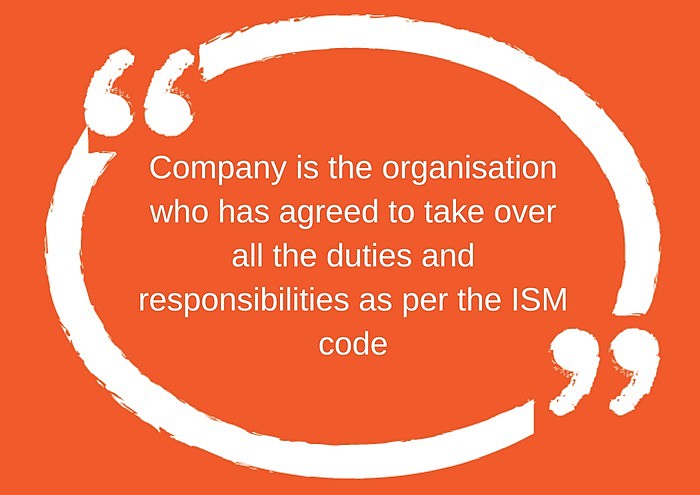
But most importantly, the company is the organisation that has agreed to take over all the duties and responsibilities as per the ISM code.
Now take it this way. If you board a ship as a PSC inspector, how can you find the details for the ‘Company” of the ship?
No ship can sail with an invalid or a missing statutory certificate. One such certificate is “Safety Management certificate”.
The details of the “company” are required to be entered into this certificate. This certificate will have the
- Name of the Company
- Address of the Company and
- Company identification number
A permanent and Unique Number is required to be assigned to all Companies and Registered Owners managing any ship of 100 gross tonnes and above engaged on international voyages.
The company identification number is issued by IHS Maritime and trade on behalf of IMO.
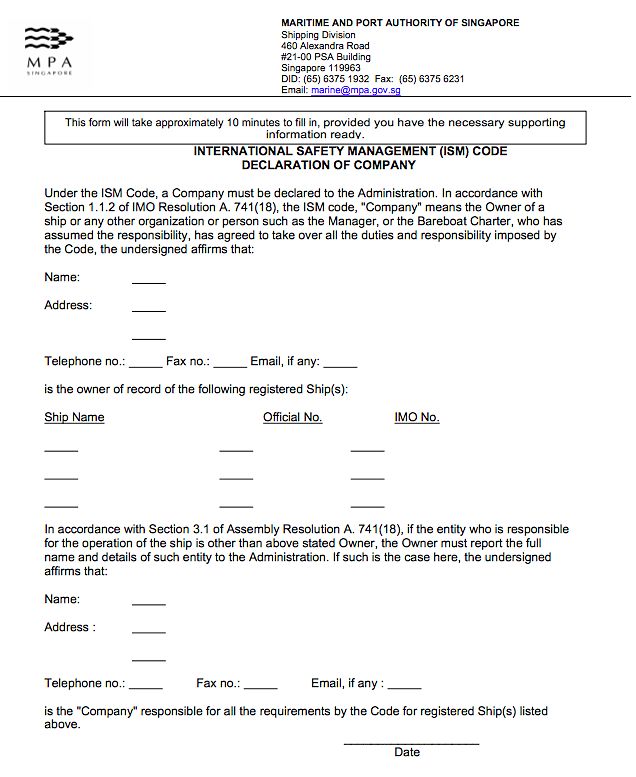
Most of the flags also require the company to fill a form called “Declaration of the company“. Which is a self declaration by the company stating they are the “company” for the listed ships as required by the ISM code.
2. Company’s responsibilities
ISM code is all about the company.
If you read the ISM code, all the lines of the code starts with “Company Should” or “Company is responsible”.
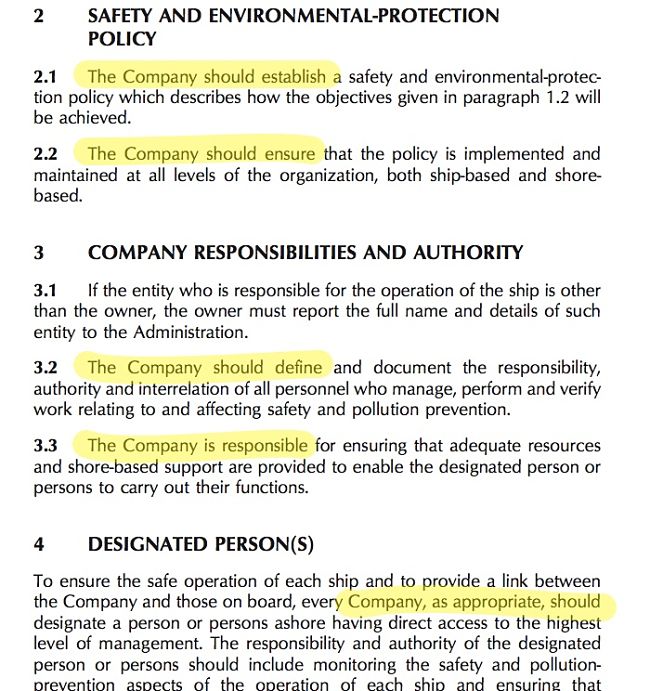
Even for the master’s responsibilities, it is not directed to the Master but to the company.
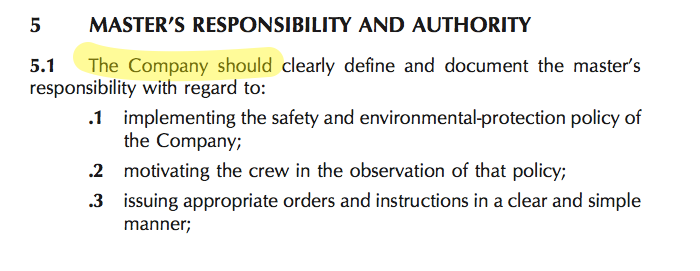
ISM code has not just made the company responsible for shipboard operations but it also its implications in the shipping business.
Take for example the Hague-Visby rules. These rules has one major rule in favour of ship owners.
It says that ship owner will not be responsible for any delays or damages resulting because of faults of master and crew of the ship.
While this rule still stays, its meaning has changed post ISM code.
Now even in the clear case of neglect on part of crew, in many cases the court has given the verdict against the ship owner.
Why ? Court asked what has the company done to avoid crew negligence ?
So ISM code is all about company’s responsibilities. Broadly there are two main responsibilities.
- To define and document the responsibilities and authority of the persons involved in work relating to and affecting safety and pollution prevention
- provide support and resources to the persons to carry out their functions effectively
The first point means that company need to provide the instructions to the ship in form of SMS manual.
Second, the company need to provide all the support a ship may need for running the ship safely.
3. Internal Audits
An effective Internal audits is the main dividing line between a good ship management company and a bad one.
ISM code requires that internal audit of each vessel should be conducted at least every 12 months.
Who is the right person to conduct internal audit ? Well, ISM code has the answer. As per ISM code
Personnel carrying out audits should be independent of the areas being audited unless this is impracticable due to the size and the nature of the Company
This means that the superintendents of the vessel cannot carry out the internal audit of the vessels they are managing.
This is because of obvious reason that they will tend to not highlight any shortcoming in the system for which they themselves has to blame for.
In most effective systems, it is always someone from the QHSE department that conducts the internal audits.
Some companies even have a “Shipboard Audit department”, whose only responsibility is to look after the internal audits of the ships.
Apart from this, there is a formal requirement for the auditor to be trained for carrying out the internal audits.
4. Certificates as per ISM Code
There are two statutory certificates that are required as per ISM code.
Document of compliance
DOC is issued to the company by the flag state or by the classification society on behalf of the flag state. The certificate is valid for five years and it requires to be endorsed annually.
DOC is issued to the company after a successful audit to verify that company complies with the requirements of ISM code.
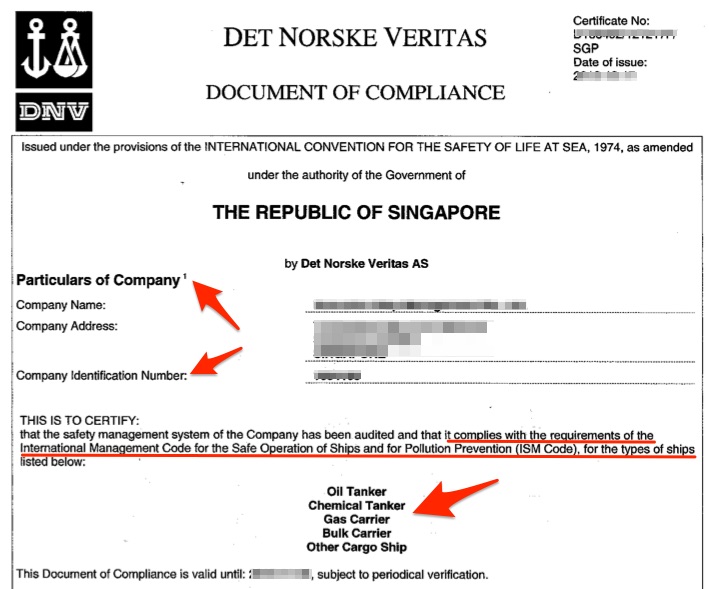
A company may have multiple document of compliance from different flags and from different classification societies.
For example, company may be managing ships of Singapore as well as Hong Kong flag. Some of these ships may have DNV class and other have Class NK. Now the company will have following DOCs
- DOC from DNV on behalf of Singapore flag
- DOC from DNV on behalf of Hong Kong flag
- DOC from Class NK on behalf of Singapore flag
- DOC from Class NK on behalf of Hong Kong flag
From the ship’s point of view, we must ensure that we have correct DOC on board.
So if you are on a chemical tanker which has DNV as the classification society and Hong Kong flag, you know what you need to check in the DOC.
Yes, you got it right !!! In this case the DOC should be issued by the DNV on behalf of Hong Kong flag.
We also need to check that the ship type appears on the DOC.
Safety Management Certificate
Safety management certificate is issued to the ship. The certificate is issued after verifying two elements required as per ISM code
- That the safety management system is in place and complies with the ISM code requirements
- That the safety management system is being implemented and followed on board
This verification process is called “external audit” of the SMS and is usually done by the class on behalf of the flag of the ship.
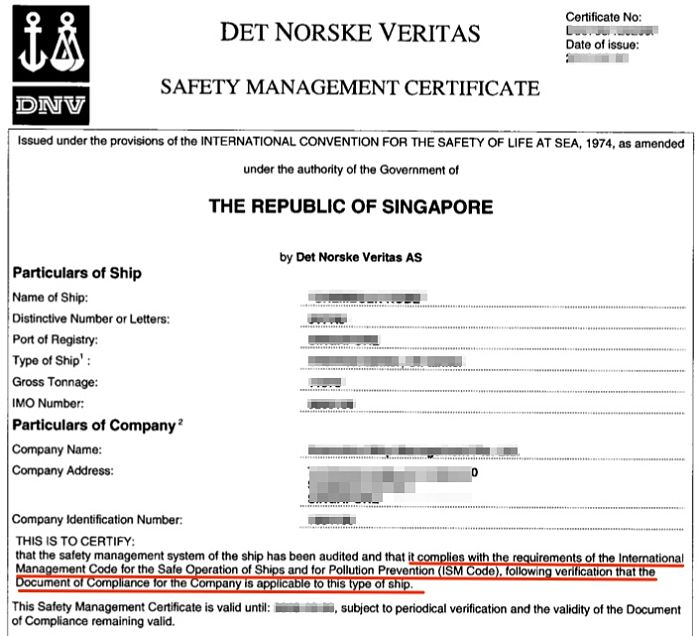
Safety management certificate is also issued by the flag of the ship or by its classification society on behalf of the flag. The certificate is valid for five years and require intermediate (between 2-3 years from date of issue) verification.
Safety management certificate co-exists with the DOC
We must understand that the issuance of safety management certificate is conditional to the validity of the DOC.
If for some reason the DOC is revoked or if it becomes invalid, the safety management certificate will also be invalid.
5. Designated person ashore
ISM code requires the company to nominate a Designated person who will be a link between ship and shore.
A Designated person ashore
- should have access to the highest level of management
- is responsible for monitoring the safety and pollution prevention aspects of the operation of each ship
- is responsible for ensuring that adequate resources and shore-based support are applied, as required
Some companies designate a junior shore personnel (for example a Deputy marine superintendent) as DPA.
While he may have gone through all the trainings required for the DPA as per MSC circ 6, he will be ineffective in carrying out his duties because of lack of authority in the organisation.
In an effective system, DPA will be a senior person in the company who has some authority and control over the company’s activities.
6. Observations, Non-conformity and Major Non-conformity
So far we have discussed that two audits are carried out on ships to fulfill the requirements of the ISM code.
- External audit by the Class on behalf of flag of the ship
- Internal audit by the company
During these audits, the auditor may find some deficiencies and shortcomings. ISM code categorises these shortcomings as
- Observation
- Minor Non-conformity
- Major Non-conformity
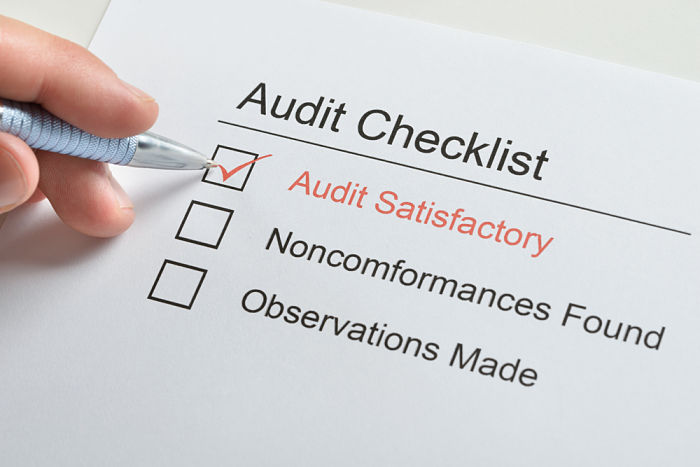
Let us see what is the difference between these findings.
Observation
As per ISM code
Observation means a statement of fact made during a safety management audit and substantiated by objective evidence
What does this means ? It shows an area of concern that is conforming with the ISM code now but if it is not improved it may lead to the non-conformance with the ISM code.
Need examples ??
Ship’s SMS requires that certain critical spares need to be on board all the time. Ship’s SMS also require that charts and publications need to be kept update and maintained in good condition.
The observation on this can be
- Two A/E critical spare parts were not on board as these were recently consumed. The requisition for same was in place.
- One of the chart was torn at the end and was found with a tape
Both of these are observations because the ship is complying with the requirement of SMS. But if these situations are not corrected, it may lead to a non-conformity.
Minor non-conformity
As per ISM code
Non-conformity means an observed situation where objective evidence indicates the non-fulfilment of a specified requirement.
This is different from an observation because in this case a specific requirement of the ISM code was not met.
In the example we discussed under “Observation”, “non-conformity” will be
- Two A/E critical spare parts were not on board as these were recently consumed. The requisition for same was not in place.
- On random checking, one permanent correction on one of the voyage chart was missing.
The SMS requires that minimum inventory of the critical spares need to be maintained at all times. In this case as the requirement under Section 10 of the ISM code (maintenance of ship and equipments) were not met.
Major non-conformity
As per ISM code
Major non-conformity means an identifiable deviation that poses a serious threat to the safety of personnel or the ship or a serious risk to the environment that requires immediate corrective action and includes the lack of effective and systematic implementation of a requirement of this Code.
If we dissect the definition, we have few elements of a major non-conformity. These are
- Deviation that pose a serious threat
- Require immediate corrective action
- Lack of effective and systematic implementation of ISM code
One point that a major non-conformity highlights is that there is a systematic failure of one or more parts of the SMS.
A major non-conformity can be because of one single major deficiency or incident. Or it can be because of number of small deficiencies from one area.
For example, a single deficiency on Marpol equipments or Life saving appliances can be a major non conformity.
Also a number of small deficiencies on record keeping can be considered as a major non conformity.
If I have to differentiate between a Minor Non conformity and a major non conformity, I will do that with one point.
A minor non conformity may be an error, something someone forgot to do or a non-compliance on a single instance.
A major non compliance is a system failure. It just indicates that the SMS is not effectively implemented.
Actions in case a major non conformity is issued
IMO in its MSC circ 1059 and MEPC circ 401 has given the detailed guidelines on the procedure to handle major non-conformities identified during ISM audits.
Few quick points about handling major conformities
- Ship’s cannot sail with a major non-conformity. Ship can only sail once it has been downgraded to a minor non conformity
- A major non conformity will be downgraded once flag is satisfied that the effective corrective actions are being taken
- Corrective actions to close this non conformity need to be completed in less than three months
- If the nature of major non conformity is very serious, the Safety management certificate of the ship may be withdrawn. In this case even the interim Safety management certificate will not be issued. Ship need to go through the initial process of obtaining the SMC which would include initial verification of the SMS.
7. Master’s review
One of the responsibility of the master as per ISM code is to review the effectiveness of the SMS on board. ISM code has not mentioned any time frame for this review but as per the understanding of industry experts, it should be done at least annually.
Master is required to report any noted deficiencies in the SMS. While reviewing SMS, Master need to
- review SMS manuals and suggest any edits or corrections. Also if any requirement mentioned in the SMS manuals is against the industry practice or requirements.
- Make suggestions to improve the safety management system on board ships
- Review and comment on the shore based support and how this can be improved
- Review and comment on the ship’s performance on safety and pollution prevention related matters
Conclusion
ISM code has been critisized for bringing too much of paper work without comparatively lesser gains. But fact is more often than not, it is the implementation, in general that has been poor.
If implemented with all the seriousness it deserves, it has many benefits to offer.