
In today’s time, it would be hard to believe that there was a time when sailors could legally throw oil in water.
That stopped with the adoption of annex 1 of the MARPOL.
Other wastes like chemicals, domestic garbage and sewage stopped soon after.
But in recent times, the emphasis has been on two sources of pollution
- Air pollution and
- Pollution from the ballast water
Annex VI of the MARPOL aimed to control NOx and SOx component from burning of fuel.
Then where does this new EU regulation fit?
EU MRV is aiming to control the emission of CO2 from the ships. In this post, I will discuss how EU MRV aims to do that and what is required out of this new regulation called EU MRV.
What is EU MRV?
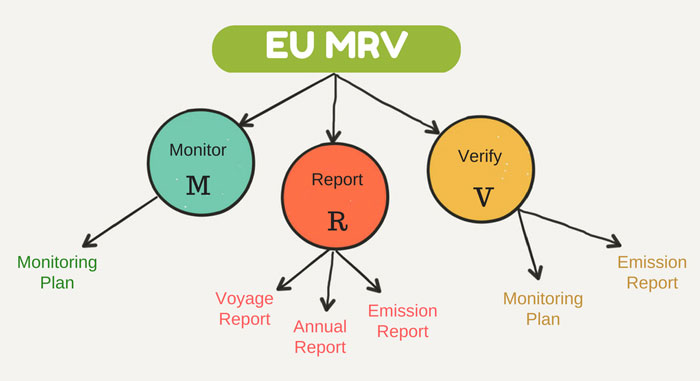
Right now this regulation does not define the maximum level of co2 emission that is allowed for the ships. Instead, it just focuses on three aspects of co2 emission
- Monitoring
- Reporting
- Verification
That is exactly what MRV stands for.
The questions that would come to our mind are,
- Specifically, what needs to be monitored
- how exactly this need to be monitored
- To whom this data needs to be reported
- Who needs to verify this data
The EU Regulation (EU 2015/757) lays down all the rules that answer these questions.
I will answer these question right here but first, we must know to which ships this EU MRV regulation is applicable for?
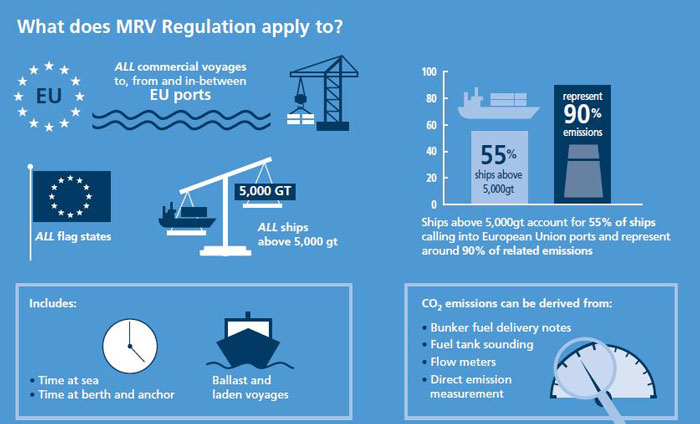
EU MRV regulation is applicable for
- All commercial ships of more than 5000 GRT, irrespective of flag, and
- operating into, out of or between a port of call in EU (EU member nations, Norway and Republic of Iceland)
[Source]
What to Monitor?
The aim of the EU MRV is to measure CO2 emission from a ship. But it has to be a value that can be compared with the other ships. And based on that data a conclusion of which ship (or the company) is greener than the other.
Now take these two examples of annual CO2 emissions from two ships
- 6000 T of CO2 emission from Ship A
- 3000 T of CO2 emission from Ship B
Which ship is greener with respect to CO2 emission?
You may be tempted to say that Ship B is greener and more environment-friendly than the ship A but that may not be true.
Here is why!!!
The ship B though have produced lesser CO2 but what if ship B has been at anchor most of the time? If so, she ought to have a lesser CO2 emission.
Similarly, if ship B was always half loaded, she ought to consume lesser fuel and thus emit lesser CO2 compared to ship A which is always operated at the fully loaded condition.
So with EU MRV what we are looking at is not the measuring of CO2 but measuring the “average energy efficiency” with respect to CO2 emission.
To calculate the “Average energy efficiency”, apart from CO2 emission we need data like
- Distance traveled
- Time at sea and in port
- Cargo Carried
As per EU MRV, for each ship following data need to be measured
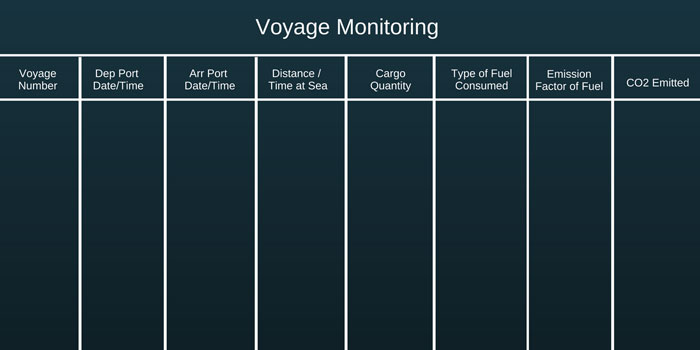
- Port of Departure/Arrival including date/time of departure/Arrival
- Amount of each type of fuel consumed
- Distance Travelled
- Time at Sea
- Cargo Carried
With respect to ship’s staff, there is nothing new in this data. Most of the ships have this data in the voyage reports.
How to Monitor?
We can calculate the each type of fuel consumed by the ship during a particular period. But how do we calculate the CO2 emission?
Annex I of the EU MRV regulation has the answer. As per Annex I of the EU MRV regulation

Annex I of the EU MRV also provides the default values of the emission factor of the different type of fuels.
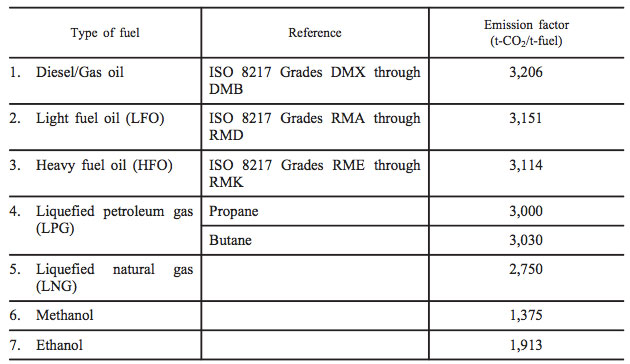
But the ship owner needs to know the emission factor of fuel being used on board their ships.
When to Monitor?
Ship needs to monitor and report the data on two occasions
- At the end of each voyage, and
- At the end of each year
Voyage reporting need to have at least the following data
At the end of the year, data for the entire year need to be compiled.
From the seafarer’s point of view, they just need to report the voyage data and annual report will be compiled by the company.
Some companies have integrated the required data with the noon-reporting software that the company is already using.
For example, Wilhelmsen ship management has integrated the required data in the noon report tool.
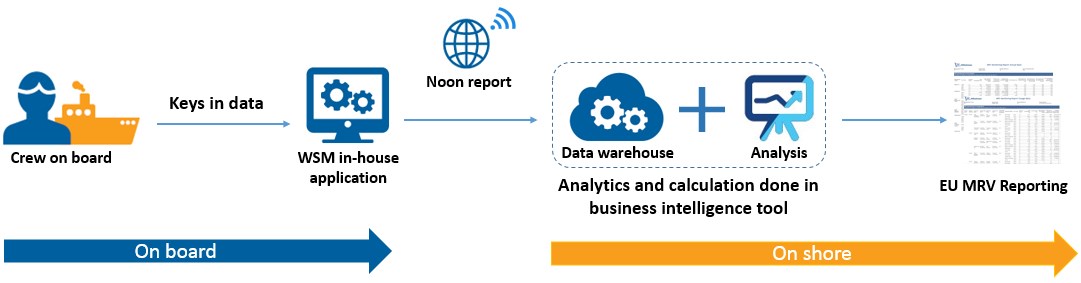
So the seafarers just need to enter the noon report data in this tool. Compilation of data and generating voyage report and annual report is done on shore.
Here is how the generated annual report and voyage report looks like.
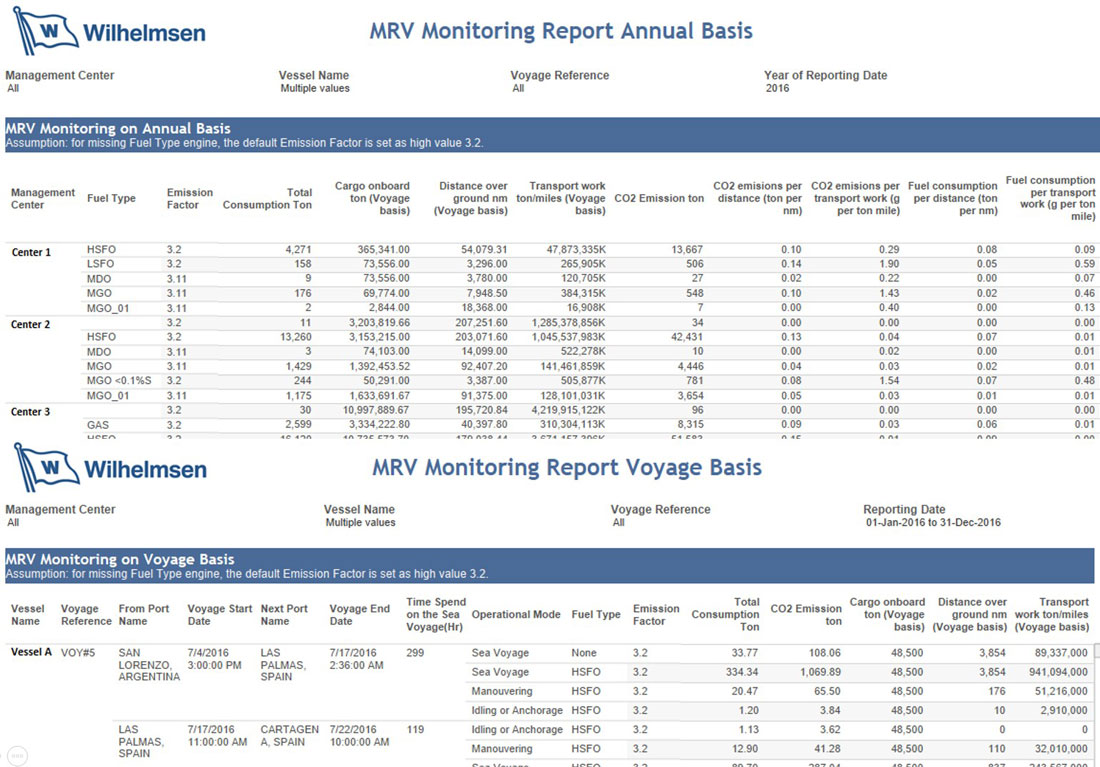
[Source] [Click for enlarge view]
Instatech marine has developed a way for automation of this whole process, that requires no or minimal manual entries.
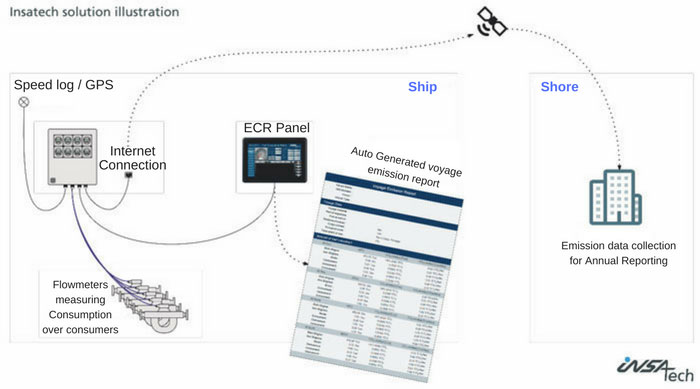
Monitoring plan
Another important aspect of EU MRV is the development of monitoring plan for each ship.
The company is responsible for the development of the monitoring plan for each of their ships for which EU MRV regulation applies.
The monitoring plans deal with the specific information on “what and how” of compliance with EU MRV for that ship.
Briefly, the monitoring plan will highlight
- All the possible sources of CO2 emission from the ship (main engine, Aux engines,
- The procedure of monitoring fuel consumption. For example, if the fuel consumption will be calculated by manual soundings or by flow-meter? Which Fuel density to use, that mentioned in BDN or in the fuel analysis report?
- What emission factor to use?
- Procedure to calculate the distance covered by the ship (Will the source be from GPS, AIS
- Procedure to calculate the quantity of cargo carried. For example what cargo quantity to use (B/L, ship figure, Vessel experience factor to be applied or not etc)?
This monitoring plan needs to be developed by the company and then submitted to an independent verifier for assessment and approval.
Few Verifiers have created tools for generating the monitoring plan the shipping companies.

In reality, most of the companies appoint the verifier itself to develop the monitoring plan on their behalf.
EU MRV has set 31st Aug 2017 as the deadline for submitting the monitoring plan to the independent verifier.
But what about the ships that do not trade in EU ports and later at some point of time need to call one of the EU ports?
EU MRV regulation, article 6 has the answer for this
for ships falling under the scope of this Regulation for the first time after 31 August 2017, the company shall submit a monitoring plan to the verifier without undue delay and no later than two months after each ship’s first call in a port under the jurisdiction of a Member State
Emission Report
As we discussed, the ships need to monitor and report the data as per the monitoring plan of the ship every voyage and then annually.
The data of the annual report need to be sent to the European Commission through a report called “emission report”.
The emission report needs to be assessed by the verifier before it is sent to the European Commission.
Apart from the data in the annual report, the emission report would contain
- The detail of the ship and the company
- Detail of the Verifier who assessed the emission report
This emission report needs to be transmitted electronically to the European commission.
The first emission report must be transmitted by 30th April 2019 and subsequent reports on the same date each year.
Document of Compliance
Another element of the EU MRV regulation is the “Document of Compliance”.
The essence of the EU MRV regulation is the emission report sent to the European commission.
The whole purpose of EU MRV regulation would be lost if
- the emission report does not contain the data as required by EU MRV regulation, or
- the data in the emission report is not in the format that is required by EU MRV regulation
To ensure that the data and format of the emission report are as per the EU MRV regulation, the emission report is required to be assessed by an independent verifier.
If the emission report is as per the EU MRV regulation, the verifier would issue “Document of Compliance” to the ship.
The first document of compliance would be issued on or before 30 June 2019.
Document of compliance is valid for a period of 18 months after the end of reporting period.
So for the first reporting period (01st Jan 2018 to 31st Dec 2018)
- The document of compliance will be issued on or before 30 June 2019,
- The document of compliance will be valid until 30th June 2020
Role of the Verifier
Apart from monitoring and reporting parts, EU MRV has this third important part. That is of verification.
Under EU MRV regulation, the verifier has an important role. EU MRV Regulation defines the Verifier as
a legal entity carrying out verification activities which is accredited by a national accreditation body pursuant to Regulation (EC) No 765/2008 and this Regulation;
So the verifier needs to be
- independent entity and not in any way related to the ship owner and the company
- accredited by a national accreditation body. This ensures that verifier has the know how of monitoring and reporting of environmental data.
Who is the Verifier?
There are many companies acting as Verifier for EU MRV and a shipping company has to make a choice to choose a verifier.
Most of the classification societies have acquired the required accreditation and can be used as a verifier for EU MRV.
But there are other companies that only specialize in EU MRV regulation. Verifavia shipping is one of the examples.
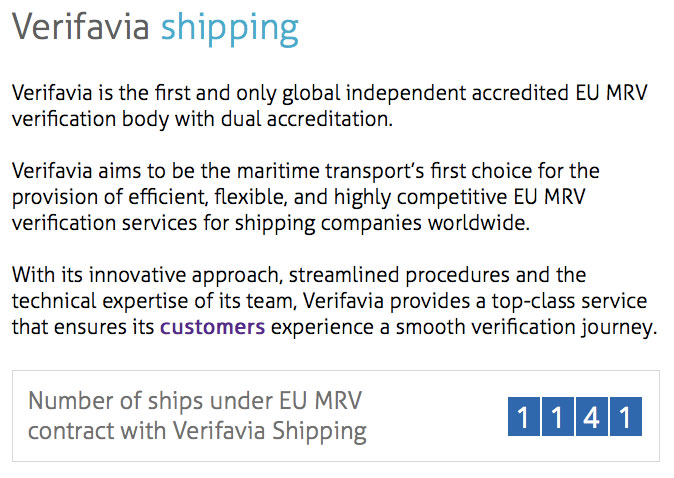
There are two major tasks of the verifier
- Assessment and verification of Monitoring plan, and
- Assessment and Verification of emission report
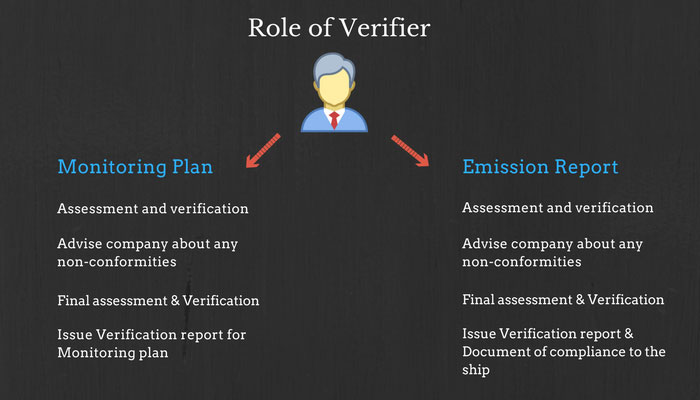
Assessment and verification of Monitoring plan
Verifier needs to assess that the monitoring plan of the ship is as per the EU MRV regulations.
Any non-conformities identified during the assessment of monitoring plan are communicated by the verifier to the company.
The company then needs to amend the monitoring plan and submit the revised plan to the verifier for the verification.
Assessment and Verification of emission report
We have already discussed this. The verifier needs to assess the emission report of the ship before it is submitted to the European Commission.
Verifier needs to assess the emission report for any misstatements, non-conformities and/or any errors. If any found, same are reported to the company for corrections.
Verifier would issue a verification statement when the emission report is in line with the EU MRV regulations.
Based upon this verification report, verifier issues the document of compliance as required by EU MRV.
Publication of data by European Commission
What would European Commission do with all the ship data that they will collect?
Well, they will publish the data publically on a website. That means anyone can have the access to this data of any ship of any shipping company.
This aspect of the EU MRV regulation has been controversial.
Ship owners are worried that shippers would use this data for further negotiating the freight rates based upon the level of CO2 emission by that ship or the ships of that company.
So the ship and the company that produces less CO2 may comparatively get higher freight rates compared to other ships/companies.
And I think that is the whole purpose of European commission to publish the data publically. To put pressure on the shipping companies to reduce their CO2 foot print.
IMO fuel consumption data collection system
Following the European Commission, on 28th October 2016 MEPC of IMO adopted an amendment to the Annex VI of the MARPOL.
This new amendment requires ships of more than 5000 GRT to report fuel consumption data to the ship’s flag.
Well, I will not discuss here this new IMO requirement but what I want to emphasize here is that there are many overlapping areas between EU MRV and IMO fuel consumption data collection system.
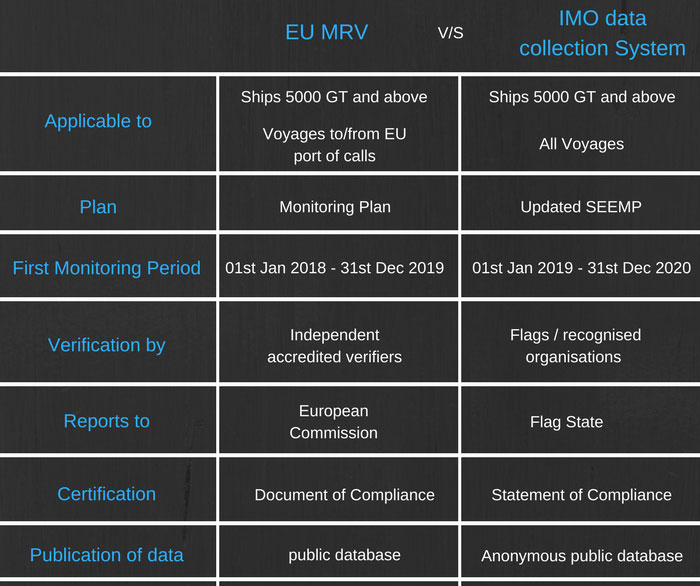
In fact barring few exemptions, both the regulations have same requirements.
There is one main difference between EU MRV and IMO regulation on data collection system.
The data published by the EU MRV will be distinct, meaning people can get the data for the each ship and company.
The data published by the IMO will be anonymous, meaning the people can see the data as per type of the ships etc but not for each ship or for a particular company.
Conclusion
EU MRV regulation is about measuring CO2 emission from the ships of more than 5000 GRT operating in EU ports.
Monitoring plan provides the information on how ships need to monitor the co2 levels.
This data once verified needs to be submitted to European Commission.
This regulation might turn out to be a game changer in reducing the CO2 emission from the ships even before it specifies the max CO2 emission level.
This is because of the every ship’s CO2 emission data that European Commission would publically upload.
The first step for the compliance with the EU MRV regulation is submitting the monitoring plan to the verifier. The last date for submission is 31st Aug 2017.
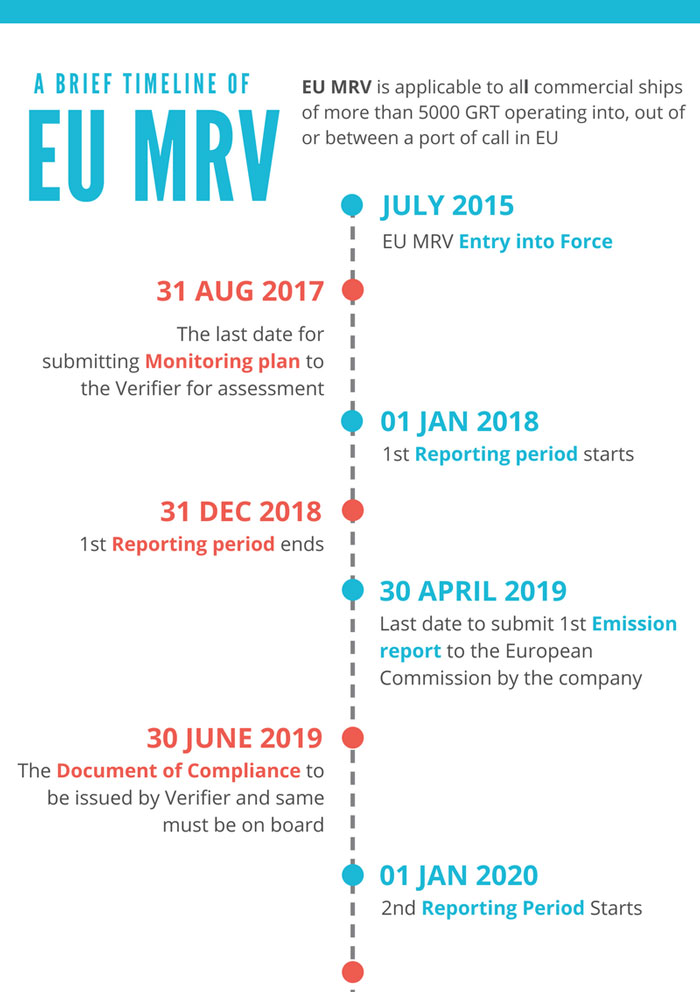
Here is the brief timeline for EU MRV regulation.
So if your ship is trading in European ports, is your ship ready with the EU MRV regulation?