I still remember the condition that was put by our first chief officer for us to enter wheelhouse and keep a watch with him. The condition was that we should know each rule of the road word by word. 18 years later, while writing this post I realize how appropriate his condition was.
When it comes to navigation and watch keeping, to be crystal clear about COLREGS is undoubtably the priority. It takes several watches to be kept under the guidance of an officer to be clear about these rules.
Problem is that we have nowadays moved from having a trainer to self training. Officers on board a ship are overloaded with their own work and so do not have time to train their juniors. In these cases, junior officers have to work on self training.
In this post we will discuss in detail 8 rules every watch keeper must know. But before we move to the rules, we must know the sections in which COLREGS are divided. This is important because not all the rules are applicable in all the situations. For example rules under Part B, Section II are only applicable when you can visually see the other vessel. So we should know which rule is applicable under which condition.
Sections and parts of Colreg
Rules of the road are divided into Five parts. These are
- Part A: General
- Part B: Steering and sailing rules
- Part C: Light and shapes
- Part D: Light and sound signals
- Part E: Exceptions
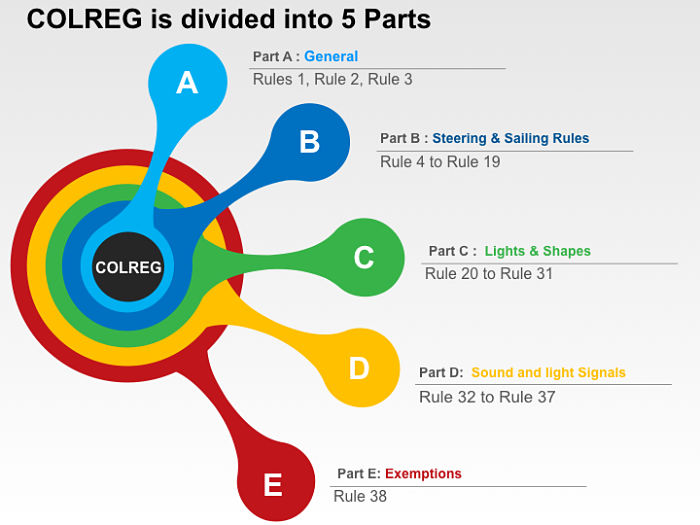
Recently in January 2016, there is another part (Part F) that has been added in the COLREG. This part deal with the verification of compliance which is not directly related to the seafarers.
Rules of part B are further divided into 3 parts based upon the state of visibility.
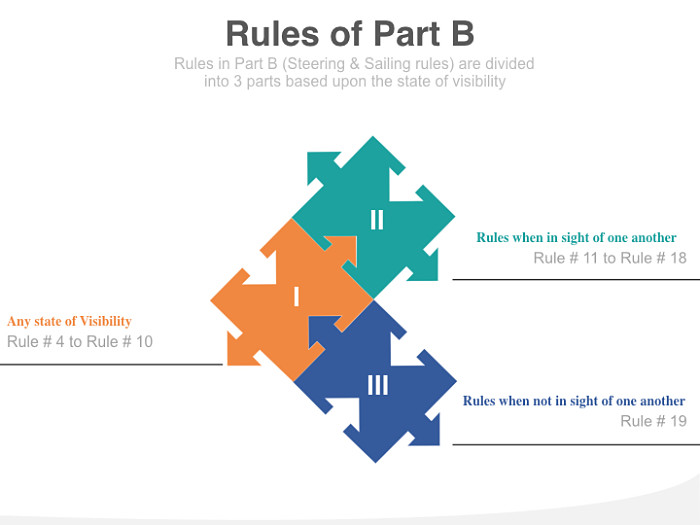
While all the rules are important, rules under part B (Steering and sailing rules) are the one that each seafarer must know at all the times. Here We will discuss some of the rules
Rule 5: Look out
If I want my ship staff to follow only one rule, I would ask them to follow rule number 5. In my opinion this is the most important rule in the entire COLREG. All other rules are based on the fact that we are aware of our surrounding. But if we fail to keep a proper look out, we would not be able to apply other rules too.
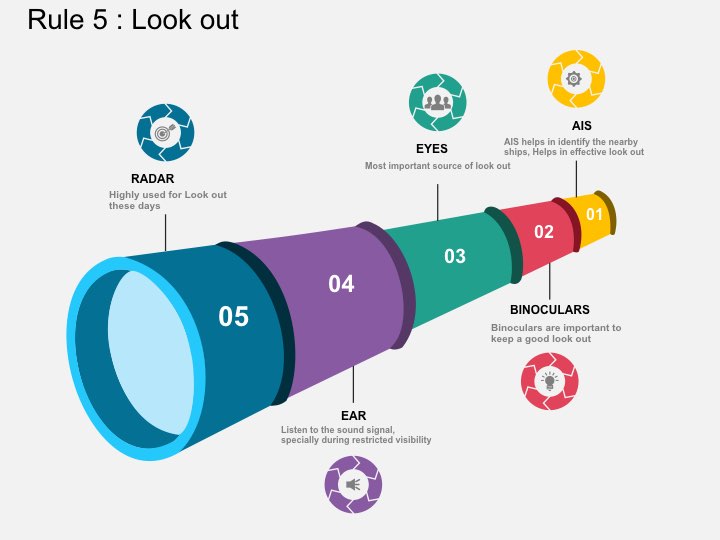
All this rule asks the watch keepers is to be vigilent by keeping their eyes and ear open. It emphasizes on three things
- By sight and hearing. Which off course means that watch keeper need to keep look out not only by sight but also by hearing. By hearing means continuously listening to VHF and distress frequencies as well as any sound signal.
- By all available means. This means that a watch keeper need to use all resources available to keep a look out. These resources can be VHF, AIS, Radar and ECDIS to name a few.
- Appraisal of situation and risk of collision. This should be the ultimate target of the watch keeper to keep a look out. A watch keeper need to look out to find any risk of collision with any vessel. Also the watch keeper should know the present situation he is in. He should also be proactive in assessing the situation he would be in after sometime. For example, he should take into account the general traffic route (such as in TSS) which may have the other ship alter her course much before TCPA.
Rule 7: Risk of collision
A good look out by sight, hearing, Radar and other available means will not miss out any targets. The next important factor of a good watch keeping is to determine if risk of collision exists.
Rule no 7 gives the guidelines on how to determine if risk of collision exists.
Risk of collision shall be deemed to exist if the compass bearing of an approaching vessel does not appreciably change.
- Approaching vessel means the distance should be decreasing and
- Appreciable change means that change in compass bearing by 2-3 deg would not mean that there is no risk of collision.
Rule 7 also warns the watch keepers about the assumption made on scanty information specailly scanty radar information.
The words Scanty information means small or insufficient information. That means the watch keeper must not assume that there is no risk of collision based upon insufficient information. Insufficient information may include
- Assuming no risk of collision just by visually sighting the target without conforming the change in compass bearing
- Assuming no risk of collision basis radar showing 0.3~0.5 NM CPA. Watch keeper should not assume that CPA shown in radar is always accurate.
- Assuming no risk of collision without conforming if the target is passing ahead or astern of own vessel. On most of the radars this is shown as BCR (Bow crossing range). If the BRC is showing empty, it means the target will pass stern of own vessel. A target passing ahead of own vessel at close range is considered more risky than a target passing stern of own vessel at close range.
- Assuming no risk of collision for a vessel at long range (more than 12 NM) on radar. CPA shown on radar for a target at long range will often have error. While Colregs recommend long range scanning on radar, assuming no risk of collision for targets at long range can be risky. 6~8 NM is a good range for assessing risk of collision. Even for targets at 6~8 NM range with no risk of collision, watch keeper need to keep monitoring until these have passed clear.
Rule 6: Safe speed
Safe speed is the most mis-undertood rule in Colreg. Let me ask a question. Which of these two vessels in Singapore strait at same location are proceeding at safe speed
- A container vessel moving at 16 knots or
- A bulk carrier moving at 15 knots
What is your answer ?
If I have to choose one, for me the container vessel moving at 16 Knots is moving at safe speed. Isn’t it interesting to say that a vessel proceeding at higher speed is safer speed ? If you understand why I chose container vessel as proceeding at safer speed, most likely you already understand this rule.
So why I chose container vessel as proceeding at safe speed ? This is because
- Container vessel is not proceeding at sea speed and has her engine ready for immidiate manoever. Whereas bulk carrier is proceeding at sea speed and would need some notice before they can reduce speed.
- Container vessels have better manoeverability compared to bulk carrier. So in case of an emergency, container vessel can manoever quickly than bulk carrier.
The whole idea behind safe speed is not to not to run into danger because of high speed. Lesser speed gives us more time to assess situation and take effective action.
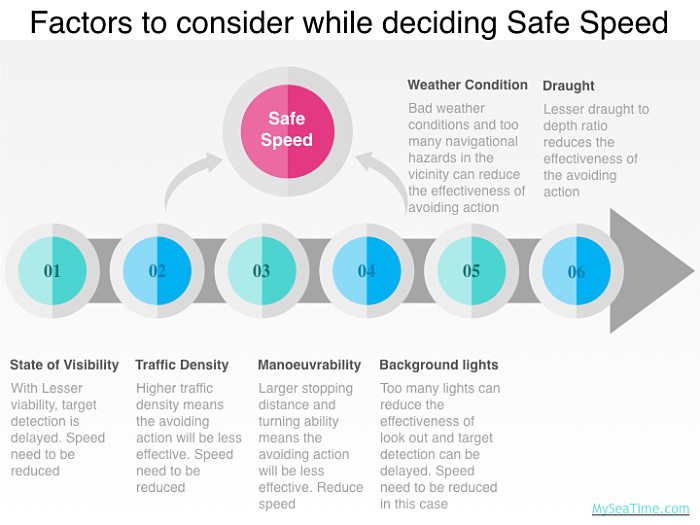
The safe speed depends upon 2 factors
- How early a target can be detected
- How effective the avoiding action will be
All the factors mentioned in the Colreg rule number 6 either affect target detection or the effectiveness of the avoiding action.
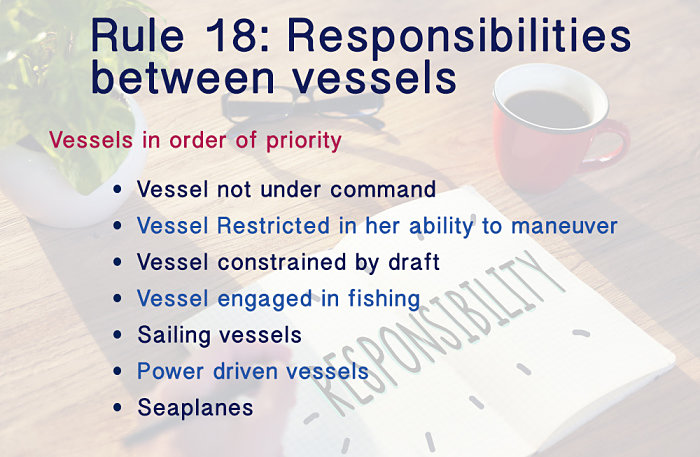
Rule 18: Responsibilities between the vessels
While this is a simple rule which list down the vessels in order of priority, sometimes we can get it wrong. I have seen watch keepers getting irritated with the fishing vessels impeding their passage. We must know that it is power driven vessel who has to keep clear of the fishing vessel and not the other way around.
Rule 15: Crossing situation
When two power-driven vessels are crossing so as to involve risk of collision, the vessel which has the other on her own starboard side shall keep out of the way and shall, if the circumstances of the case admit, avoid crossing ahead of the other vessel.
This rule is simple. In a crossing situation with risk of collision, if you have a vessel on your starboard side, you are the give way vessel. In same situation if you have a vessel on your port side, you are the stand on vessel.
This rule also guides about what action a give way vessel need to take to avoid risk of collision. It asks the give way vessel to avoid crossing ahead of the other vessel. More often this can be achieved if the give way vessel alter her course to starboard.
But can the give way vessel alter her course to port ? The rule uses the words “If the circumstances of the case admit“. Which means that if the circumstances do not allow, the give way vessel can in deed cross ahead of the other vessel by altering her course to port. These circumstances can be when
- there are number of vessels on the starboard side of the give way vessel. In this case altering her course to avoid one situation can lead to another close quarter situation.
- There are number of navigational hazards on the starboard side of the give way vessel. In this case altering her course to starboard can lead her to danger.
While rule no 15 does not prohibit altering course to port, this should only be done if it is completely unavoidable. And if you are passing ahead of the other vessel, you should not do this in the last minute. This should be done well in time and your intentions should be known to the other vessel.
Rule 14: Head on situation
This is the easiest rule in the Colreg but a must know by all watch keepers. When in head on situation, each vessel alter her course to starboard side. It is as easy. A little trick however is in the definition of the head on situation. For example in rule 14, pay attention to the words Reciprocal or nearly reciprocal, “ahead or nearly ahead” and “in line or nearly in line”.
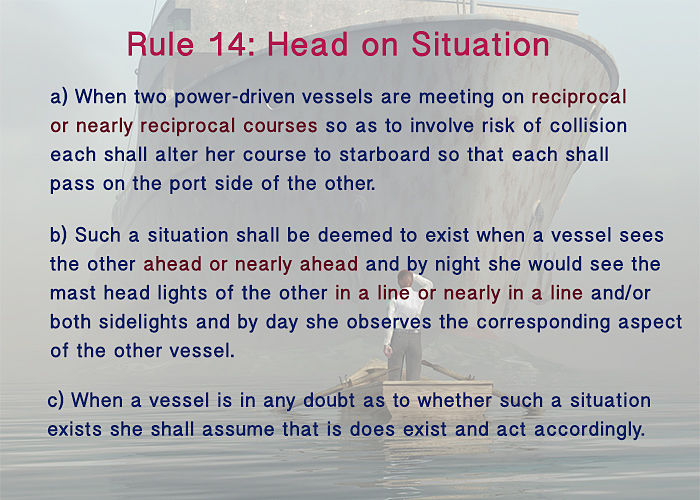
These three terms are what differentiate head on situation from crossing situation. But what does nearly means ? Or rather how many degrees nearly means ?
Nearly is again a very relative term. For example if you are on a course of 000 Deg, what would be the limit of nearly reciprocal course of target vessel ? 178 Deg, 175 Deg or 170 Deg ??
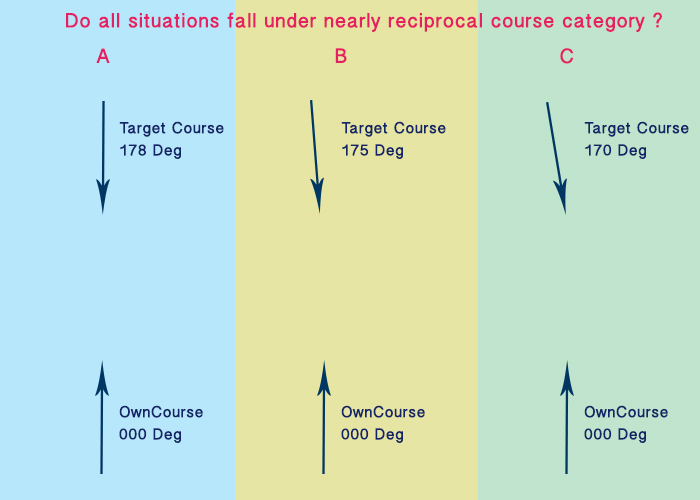
Frankly it would be a challenge for anyone to answer that question. But we do not need to know the answer. Whenever you are in any doubt if it is head on situation or crossing situation, you need to assume that it is head on situation. Why ? Because rule no 14 (c) says so.
Rule No 13: Overtaking situation
When we were appearing for 2nd mate’s competency exams, there was this one COLREG question that was hot cake.
A NUC (Not under command) vessel is overtaking your vessel (power driven vessel) with risk of collision. Who is the give way vessel and what action you would take ?
Many would be tricked by this question with the presence of NUC vessel. Many would think that NUC vessel has some limitations and we would need to keep clear of the NUC vessel.
We may even apply Rule no 18 (responsibilities between vessels) to support our belief that NUC vessel is the stand on vessel. The answer to the question lies in the first sentence of the rule 13 (overtaking situation) which says
Not withstanding anything contained in the rules of part B section I and II…..
In simple word this one sentence means that it does not matter what other rules in part B section I and II say, this rule takes the priority. Rule 18 falls under “part B, section I and II” and so for overtaking situation it does not apply.
Even the first sentence of rule 18 clarifies this, which says
Except where rule 9, 10 and 13 otherwise require ….
Now what is overtaking situation ? As per rule 13,
A vessel shall be deemed to be overtaking when coming up with a another vessel from a direction more than 22.5 degrees abaft her beam, that is, in such a position with reference to the vessel she is overtaking, that at night she would be able to see only the sternlight of that vessel but neither of her sidelights.
So as per rule 13(b), See below difference between an overtaking situation and a crossing situation. Do you agree ?
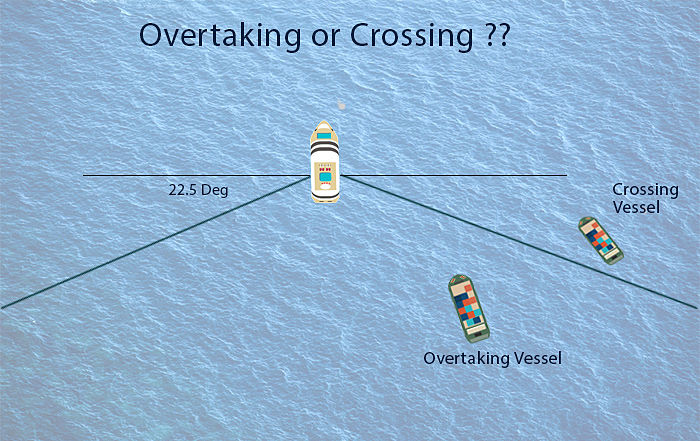
Everything seem alright upto this point. But any vessel which is crossing from abaft the beam may have been in the overtaking zone at some point of time.
In our example, see what would have been the situation few minutes earlier. So is this an overtaking situation or crossing situation ??
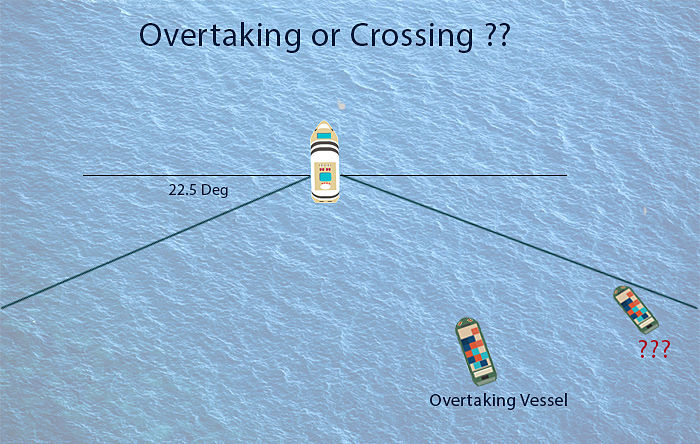
I mean what is the time when we need to make the assessment if the another vessel is 22.5 degree abaft the beam or not ?
Overtaking rule falls under Section II of Part B “When in sight of one another”. The visibility of stern light is 3 miles. So we need to need to assess the situation at 3 miles. We do not need to wait till the vessels are at 3 NM distance but we can make the assessment if at 3NM the other vessel will be 22.5 deg abaft the beam or not.
But as the rule 13(c) points out, if the overtaking vessel in doubt she need to assume that this is overtaking situation.
Rule 19: Restricted Visibility
The compliance with rule no 19 is based upon two situations.
- Situation where target is detected by radar alone
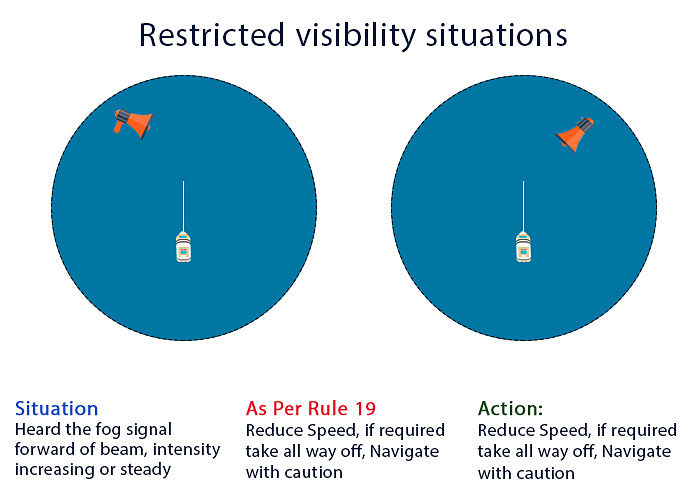
- Situation where sound signal is heard
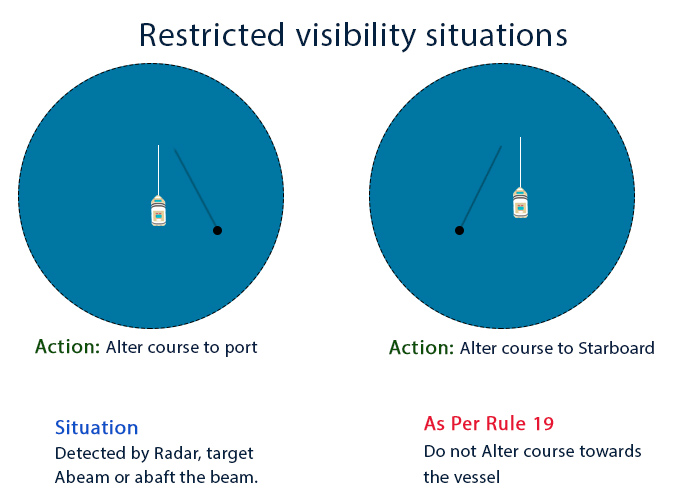
Situation where target is detected by radar alone and risk of collision exists.
In this situation, action to avoid risk of is also divided into two situations
- Target vessel forward of the beam.
- Target vessel abeam or abaft the beam
For target vessel forward of the beam, alternation of course to port need to be avoided, other than vessel being overtaken.
For target vessel abeam or abaft the beam, alternation of course towards the vessel need to be avoided.
Lets see each situation and action that we are required to take.
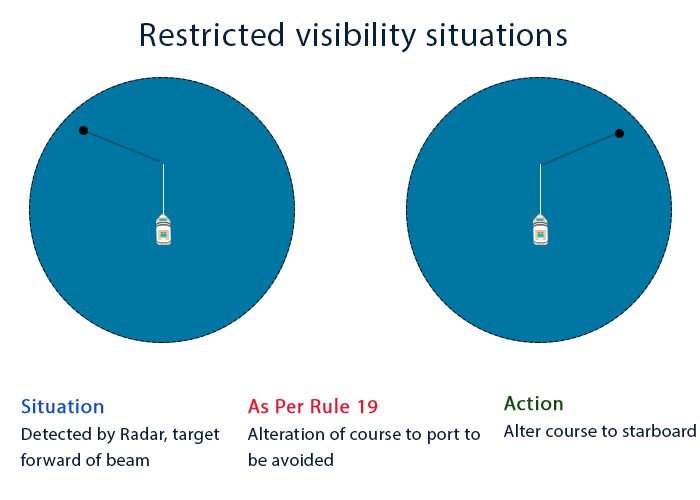
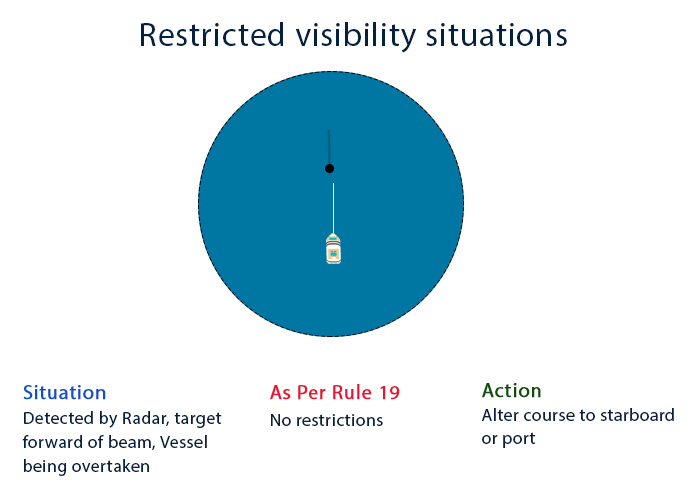
Situation where sound signal is heard
Watch keeper need to worry about the fog signal heard forward of the beam. In case a fog signal is heard forward of beam, we should reduce our speed. If we think that risk of collision still exists, we should reduce speed further upto where vessel can be kept on her course.
We also need to address what visibility is restricted visibility ? If the visibility is 3Nm, will it be considered as restricted visibility ? What about 2NM or 4NM visibility ?
Let me put it in another way.
Visibility is around 2NM and on your radar screen you plot a vessel which is head on at 6NM on reciprocal course. Would you take action as per rule 19 (restricted visibility) or as per rule 14 (head on situation) ? I bet your answer is rule no 19.
Assuming both vessels did not take action and now the vessel is at 2.5NM and you could see the vessel visually. The vessel is still on collision course. Now will you take action as per rule 19 or rule 14. Remember we are still in area of restricted visibility where visibility is around 2NM. This one is tricky and we will come to the answer later.
Another situation is that in one part the visibility is 2NM and another part the visibility is 5NM. Will you apply the rule 19 or rules under “in sight of one another”.
Well, I have asked enough questions. But I asked all the questions in one go because all these questions have one answer.
And the answer is it does not really matter if you will apply rule no 19 or other rules. Actions required under rule 19 does not contradict actions as per other rules. Let us assume that in restricted visibility, when in head on situation at 2NM both vessel take action as per different rules. That is you take action as per rule 19 and target vessel take action as per rule 14.
So what will be action by both vessel. If you notice action as per rule no 19 will be “Not to alter course to port”. And action as per rule 14 will be “Alter course to starboard”.
Conclusion
Understanding of the rules of the roads is the first requirement of being a navigating officer. If our understanding of these rules is crystal clear, half the battle is won. While all the rules in COLREG are important, these 8 rules we discussed above are top most priority. Once we know these rules and what is expected out of us, we can be sure of keeping a safe watch.