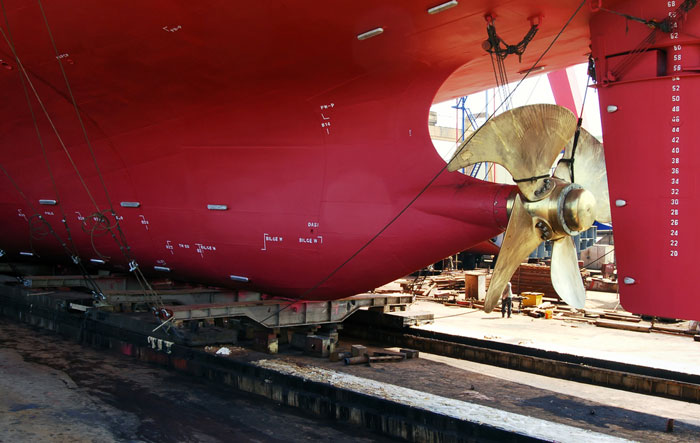
If you have the experience of dry-docking of a ship, you would agree that dry docking is a great experience.
I personally love to be on a ship due for dry dock. After all, you get to see things that you don’t see during the routine operation of the ship.
I was lucky enough to get a chance to be in dry dock in each rank I have served on. I was even lucky to experience the double-hull conversion of a tanker during dry dock.
But if you have not been to a dry dock, there would be one thing that might come to your mind on hearing the word Dry Dock. And that is dry dock calculation that we read in ship stability, probably during our Mate’s exams.
That’s purely the theory part. And I believe theory without practical experience is just a theory.
So here I am going to write about the practical aspect of taking a ship to dry dock.
But before I proceed, in layman’s terms I will summarize what we had read about dry docking in ship stability.
We read and understood these things
- The time from “when Stern touches the blocks” to when “full ship is on the blocks” is the critical period.
- During the critical period, the vessel’s GM reduces. This is because the vessel’s ‘Gravitational center G moves upwards when Stern touches the blocks.
- It is required and a good practice to have the least trim while docking so that the critical time is minimal.
Preparing for Dry Dock
Well, I am not going to the company-specific parts of dry docking, like preparing repair specifications.
I will specifically be talking about taking the ship into the dock and making it sit on the blocks.
And then, of course, bringing the ship out of the dry dock.
Days before the planned dry dock, Dockmaster will make the first contact with the ship. He can do so either directly or through the company representative such as superintendent.
The dockmaster has a huge responsibility for calculating the stresses on the dock as well as the ship’s structure. Any miscalculation can lead to serious accidents resulting in huge damages. These damages can be to the ship as well as dock itself.
The dockmaster is trained for block arrangement and stability during dry-docking. For all these calculations, the dockmaster needs certain information from the ship. Among other things, he will ask for
- a copy of Vessel’s Docking plan
- Arrival Stability condition-docking condition
- Pre-docking condition
Some of the content of his email might look something like this
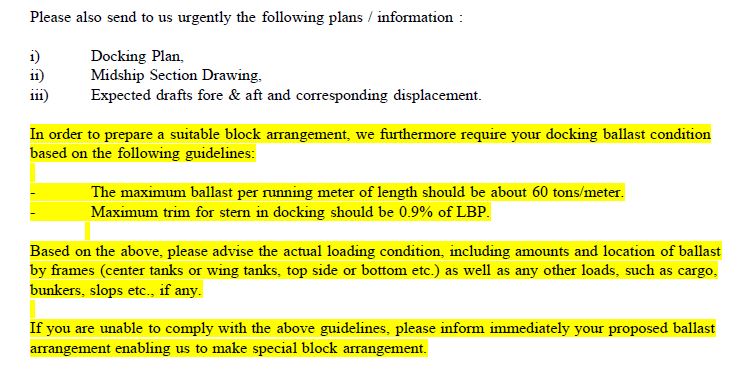
From the docking plan, dock master wants to know
1) Hull structure so that he can arrange the blocks to support the ship’s hull.
2) locations of transducers for log and echo sounders so that these do not come beneath the blocks.
3) Location of sea chests and drain plugs for the same reason.
Based on the docking plan provided by the ship, the dock master prepares his own docking plan for the ship. Below are some of the sections of the actual docking plan prepared by dockmaster for s ship arriving for dry dock.
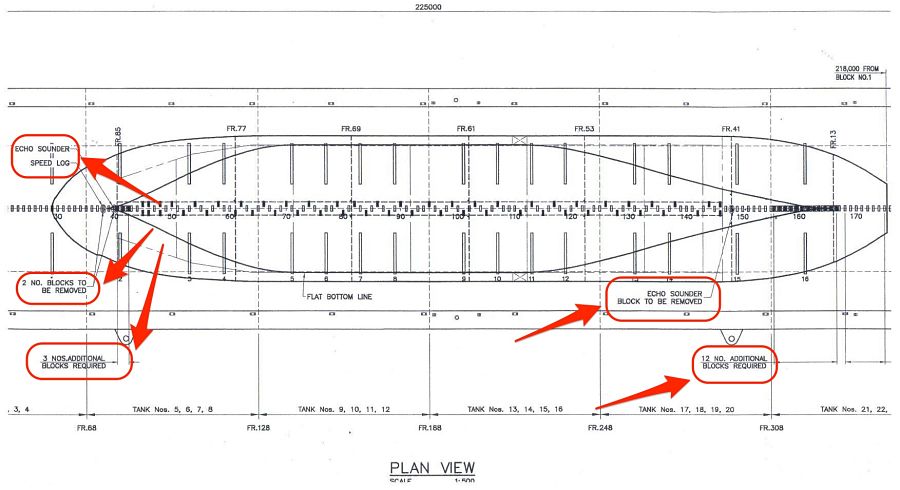
As you can see, the dock master has planned which blocks he needs to remove and where he needs to put blocks. He also has specifically marked the location of echo sounder and speed log.
Have a look at the closer view below, which is again from the same docking plan prepared by dock master.
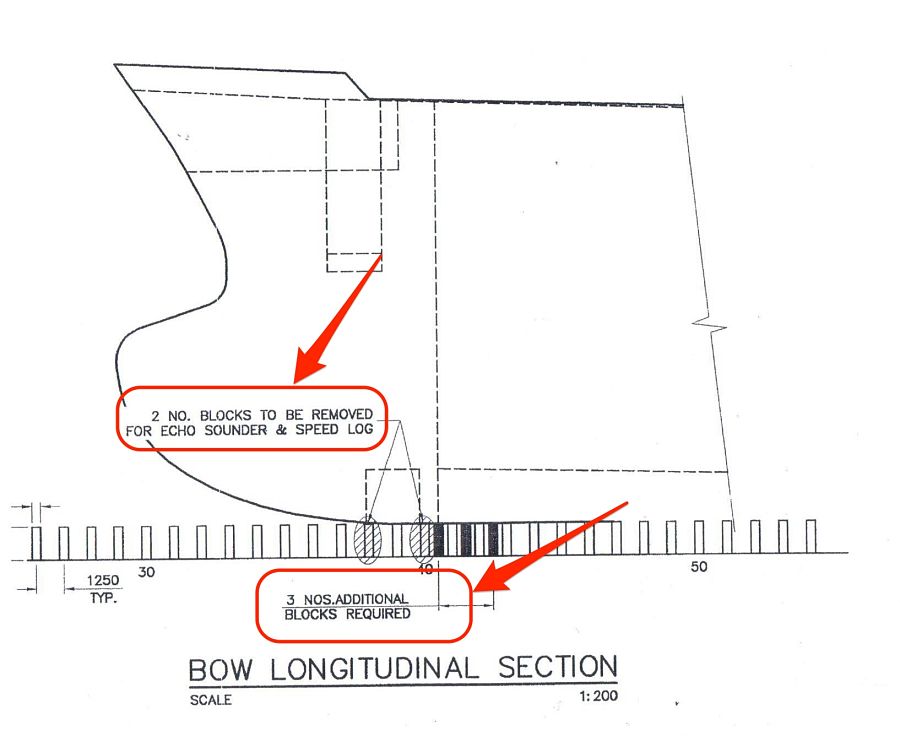
I think the above image makes it more clear about what dockmaster is trying to achieve from the docking plan. If you want to see the stern view too. Here is it.
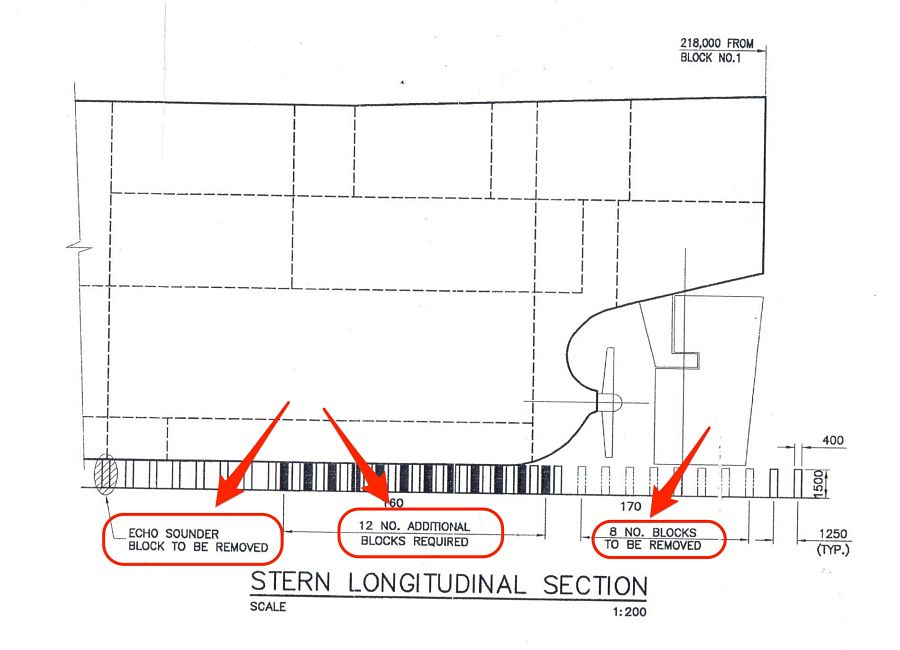
And this is no theory. This is an actual docking plan prepared by the dockmaster for a ship arriving at dry dock.
I know I am kind of repeating myself but I can’t say it enough. That is because I get excited to see real things than just theory.
Stability condition and weight distribution
Apart from the docking plan, the dock master would ask the arrival weight distribution of the ship.
There can be up to 4 stages for which stability calculations are required. These stages are
- Arrival Drydocking port
- Pre-docking condition
- Ship sitting on the blocks but dock not yet empty (also called wet condition by dockmaster)
- Ship on the blocks and dock empty (called Dry condition by docking master
Let’s discuss each of this condition
Arrival Drydocking port
On arrival dry docking port, you need to have the least possible ballast. By least possible I mean, the propeller should be immersed. And also you should be complying with all stability requirements.
Pre-docking stability condition
So we know that we cannot arrive with zero ballast as our propeller needs to be immersed and the ship needs to be stable.
But what is the logic behind having the other three conditions? Why can’t we just remove all the ballast and go inside the dock?
Let’s understand the logic behind these conditions
Docking with zero ballast is the ideal condition. But most of the time this would not be possible. That is because a docking master would limit you for the maximum trim that you can have. In zero ballast condition, your trim may be more than 2 meters.
Dockmaster would want you to reduce the trim to around 0.5 meters. This depends on the dock on how much trim you can have before docking.
We have already discussed the reason for the need for the least trim while docking. This is to have the least critical period. More trim we have more will be the time required to bring the vessel from stern on the block to full ship on the block. And this is the critical period with the least GM value. We do not want to have the ship in a critical period for a longer time.
Most of the ships will have considerable stern trim in lightweight condition. So most ships will need to have some ballast forward in Pre-docking condition.
The amount of ballast would depend on how much trim dockmaster has advised you to have.
Stability condition while the ship on blocks but dock not empty
When the ship is on the blocks, you have already passed the critical period. Dockmaster will tell you to start deballasting. The only concern dock master will have is the ship should not refloat.
The ship can refloat if dock deballasting cannot compensate for the decrease in the draft because of deballasting.
The condition is monitored by the dockmaster and he would tell you how much ballast you can remove in this condition.
But the question is why the dockmaster need the vessel to remove the ballast concurrently when he empties the dock?
This is because dock water does not want to have more weight on the blocks. When the ship is sitting on the blocks but has water inside the dock, there is a certain amount of buoyancy ship has. This buoyancy acts like upthrust which reduces the effective weight acting on the blocks.
This condition will be discussed by the dockmaster and he will advise when and how much ballast you can remove.
As I said earlier, the dock master bases his calculations on not to allow the ship to refloat.
Ship on the blocks and dock empty
When the ship is on the blocks and there is no danger of ship re-floating, dock master will tell to take out all ballast.
Dock masters sometimes call this condition as the Dry condition.

Procedures for taking the ship to dry dock
Now that we know about the stability part, let’s look into each stage of taking the ship to the dry dock.
Arrival to the dry-docking port
As I mentioned, you would arrive with the least ballast. That would be arrival dry docking port condition. Even though the ship will be complying with draft and stability requirements, but the ship will be light. Lighter than usual ballast condition. So before you arrive at this condition, it is important to scan the weather reports. You would not want to arrive in a light condition if the weather prediction is rough.
Most of the time, the ship is taken to the lay-up berth before going into the dry dock. If not, the vessel needs to be at anchor for deballasting to arrive at the Pre-docking condition.
While at anchor, dock safety inspector will board the vessel. He will do the gas check of all the compartments to make sure that the vessel is gas-free. He will then issue a gas-free certificate. He will also give safety booklets of the dock which will have all the safety regulations of the dock.
Docking of the vessel
The vessel will dock when it has achieved the pre-docking condition. In this condition, the vessel will have the least ballast to achieve the required trim.
Before docking, the dock master will board the vessel. He will discuss the docking procedures with the master and chief officer. He will give the mooring arrangement plan while docking. He will specify Panama leads from where the moorings will be passed.
Apart from this, he will also discuss the ballast condition at each stage.
For shifting to the dock, the pilot will board the vessel. As the ship’s engine will not be available, the ship will have a number of tugs to move the ship to dry dock. The number of tugs would depend on how big the ship is and how powerful the tugs are. In any case, all ships can expect 5 tugs or more.
Out of these 5 tugs usually, 2 will only be assisting for pushing. Different docks can have different arrangements for making fast the tugs. It will all depend upon the location, tidal current, and local factors.
One of such arrangement can be two tugs made fast forward, one made fast aft and two tugs standby. The one tug made fast aft will have one line on each side of the poop deck to have better control in handling the ship.
Depending upon the dock, the ship will either enter stern in or bow in.
The pilot will bring the ship to parallel to the dock. When the stern (or bow whichever is entering first) is close to the dock knuckle, the docking master will take over from the pilot. Docking Master is different from dock master. Docking Master may not board the vessel and will be giving instructions to the tugs from the dock itself.
When the ship is inside the dock, the ship’s crew needs to pass the mooring lines as per the agreed mooring arrangement. Usually forward and aft will have two lines on each side. Out of two lines on each side, one on each side can be a shoreline. But this can be different and mooring arrangements will be advised by the dockmaster.
When the ship is made fast with the moorings, docking master will sign off and dock master will take over.
The vessel on the blocks
Before the dockmaster starts to remove dock water, a diver will make an underwater inspection. The diver will ensure that echo sounder and log sensors are clear and not sitting under the blocks. He will also ensure physically that the vessel’s centerline is in line with the blocks. It is a good practice to switch off the echo sounder and speed log now.
After the diver has made his inspection, the dockmaster will start pumping out dock water.
Dockmaster will let the vessel know when Stern has touched the blocks and when the ship is on the blocks.
After the ship is on the blocks, the dockmaster will tell to start pumping out the ballast to arrive at the wet condition.
As the dock water is being pumped out, at one point the water will go down from the generator cooling water sea chest.
After this point ship will get power supply from shore.
A shore electrician will board the ship (Through basket and shore crane) and make arrangements to connect the shore power. Ship’s Electrician should coordinate with him to have the shore power connected.
You should check if shore power will be enough for running the ballast pump and mooring winches. If not, this should be discussed with the dockmaster in advance. He will then ensure that the water level does not go below sea chest until you have pumped out the required ballast.
Once on shore power, dock master would continue to dry the dock. He will tell you to take out all the ballast accordingly. You may do so with gravity as the same might be more effective.
Once the dock is dry and ship sitting on the blocks, you can line up to deballast all ballast tanks by gravity. This is to let all the water drain whatever is left in the ballast tanks.
So now you have already brought the ship to the dry dock. It is a wonderful view to see the ship out of the water. You should not wait to go down in the dock and have a look at her.
Removing the Drain plugs
The Ship repair manager will now request the chief officer to witness the removal of the bottom plugs.
As you know, each tank which forms part of the hull has a bottom plug to drain the water in dry dock.
Removing bottom plugs ensure that the tanks are empty and dry. As the bottom plug of each tank is removed, it is important to label it. This will ensure that bottom plugs are not interchanged while fitting back.
Though plugs of all the ballast tanks are of the same size, it is best practice to fit back plugs which belong to each tank.
If you wish to experience how we remove the bottom plugs, watch this video.
Departure from Dry Dock
After a few hectic days in dry dock, it would be time to leave dry dock. We need to be equally attentive in leaving the dry dock as we were while coming into the dry dock.
Before dock master floods the dry dock, all the underwater things need to be in order. This includes sea chests, ICCP system, echo sounder sensors, log sensors, and drain plugs.
Echo sounder, log and drain plugs are tested for air and water tightness. Testing involves first putting soap solution around the drain plug. Then we create the vacuum around the drain plug and look for any bubbles.
If you have never experienced this testing before, here is a video of the testing the drain plug.
After all these integrity tests are complete, it is time to leave the dry dock.
The best approach of leaving the dry dock is to follow exactly how the ship came into the dry dock.
It would involve
- Filling the ballast to bring the ship to wet condition.
- passing the lines as was in the arrival condition
- Flooding the dock
- Filling the ballast to pre-dry dock condition
- Flooding the dock up to the level where the ship is fully afloat.
- Disconnecting the shore supply and taking ship’s generators on load
- Taking the ship out of the dock with the help of tugs.
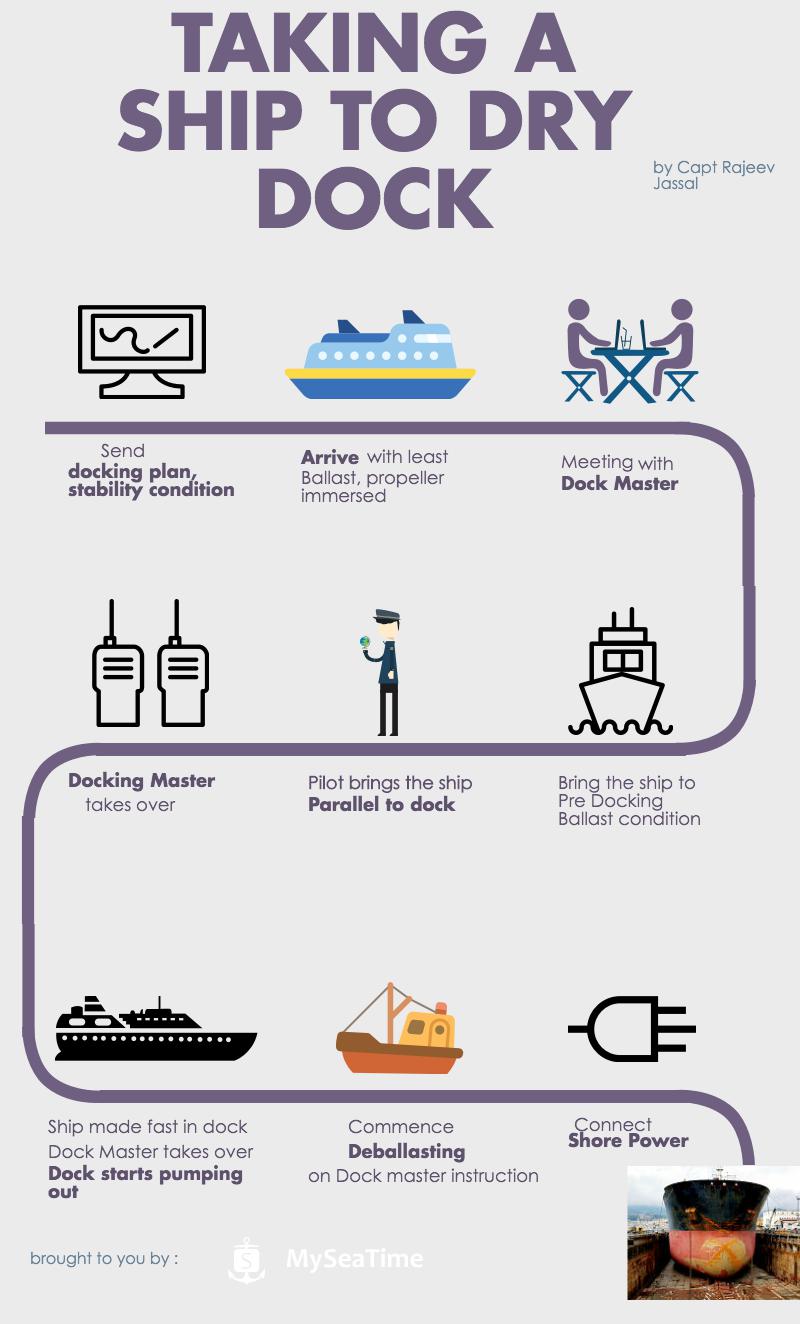
Finally to summarize the process of bringing a ship to the dry dock, here is an Infographic
Conclusion
Drydocking is a great experience for those who do not want to stop learning. The special thing about dry docking is that there are plenty of things that a seafarer can learn each time he attends a dry dock.
While it might seem to be a difficult process but if we view the whole process logically, it would seem a routine.
If you are going to a dry dock, Enjoy the learning process. And let me know in the comments below if there was anything that should form a part of this guide.