Incoterms is the short form for International Commercial terms. These terms relates to the sales contract and are used worldwide. INCOTERMS were first introduced in 1936 by International chamber of Commerce (ICC). These Incoterms were revised several times, latest being Incoterms 2010.
Why do we need INCOTERMS ?
A cargo may move several days before it arrives at its destination. Even though shipping is safer these days, many cargoes still do not reach their destination or reach in bad shape. And when that happens, one should know who had the title of the goods lost. For that reason, It is important for buyer and seller to pre-define the responsibilities and obligations for transport of the goods. INCOTERMS are all the possible ways of distributing responsibilities and obligations between two parties.
These responsibilities and obligations include
- Point of delivery: Incoterms defines the point of delivery of the goods by seller to buyer. The meaning of delivery here is”transfer of risk and responsibility”. So the INCOTERMS defines the point of change of hands (passing of risk) from seller to buyer.
- Transportation Costs: Incoterms defines which party pays for the transportation cost. There may be more than one means of transportation and INCOTERMS defines who pays for which leg of the transportation. In case of sea transport, it also means which party will act as shipper of the cargo.
- Export and import formalities: Incoterms outlines which party arranges for export and import formalities.
- Insurance costs: Incoterms outlines who bears the insurance costs.
There are few important points that requires highlighting before we move any further.
- Arranging for the main transport does not mean the risk is with the arranging party. Seller may arrange for the main transportation even when the consignment is already delivered (that is risk has passed to buyer). In this case the risk has passed to the buyer and seller is just acting as the shipper without any risk to him.
- Arranging for the insurance does not mean that risk is with the party arranging the insurance. In few of the INCOTERMS, seller arranges for insurance to cover buyer’s risk. In these cases, seller is only required to cover minimum risk as defined in the minimum risk clause in respective incoterm. Buyer must take more insurance to cover any extra risk that he wishes to insure against.
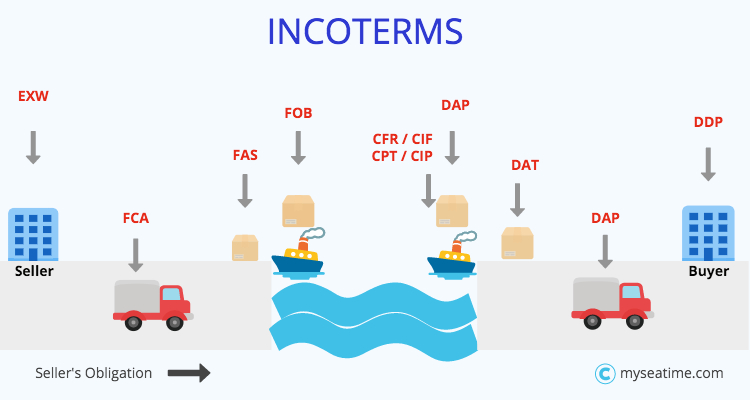
There are total 11 INCOTERMS defined by the ICC . The 11 INCOTERMS are based upon the consideration of least responsibility of the seller to least responsibility of the buyer. For example INCOTERM EXW (ex-work) considers least responsibilty for the seller. Same way INCOTERM DDP (Delievered duty paid) considers least responsibility for the buyer. We can say that all other nine INCOTERMS lies between these two extremes.
One last thing before we take the incoterms head on. Lets differentiate and group together each Incoterm. First on the basis of mode of transport that they are used and second based upon the point of delivery.
Incoterms Based upon the Mode of transport.

The first group includes seven incoterms which can be used in any mode of transport. These can be used even when there is no sea transport used. Incoterms EXW, FCA, CPT, CIP, DAT, DAP and DDP belongs to this group. The second group includes four incoterms which are used in sea or inland waterways only. This is because in these incoterms the point of delivery and the destination place are both sea ports. Incoterms FAS, FOB, CFR and CIF belongs to this second group.
Incoterms groups based upon point of delivery
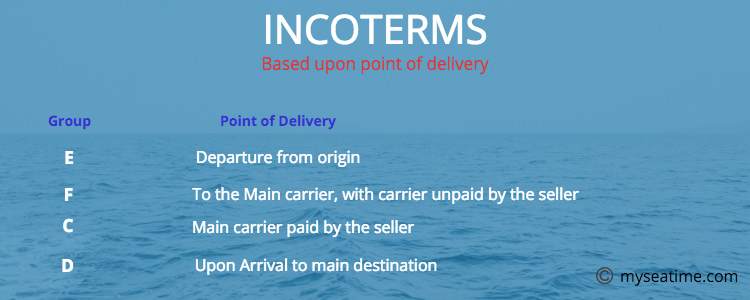
Incoterms can also be grouped together in 4 categories based upon the point of delivery. In group “E” (Ex-works), the delivery point is seller’s premises. In group “F” (FOB, FAS & FCA), the delivery point is before or upto the main carrier, with main carried unpaid by seller. In group “C” (CFR, CIF, CPT & CIP), the delivery point is upto and beyond the main carrier with carrier paid by seller. And finally in group “D” (DAP, DAT & DDP), the delivery point is the final destination.
Now that we are clear on some of the important points, lets jump into each of the incoterm.
1. EXW (Ex-Works):
Mode of transport: Multimodal
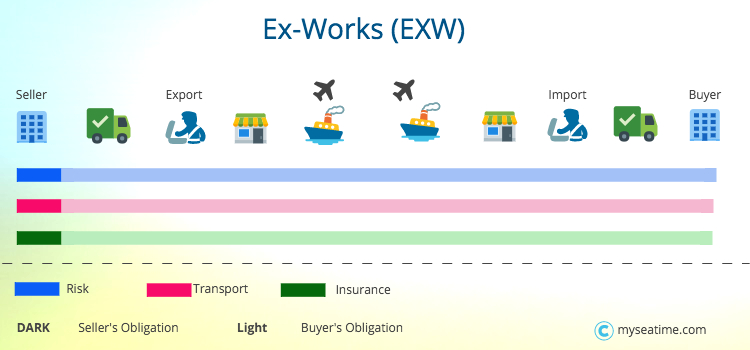
With Ex-works the seller has the least responsibility. Seller has the responsibility to deliver the goods to the buyer at seller’s premises, depot or any other agreed places. From there on, all responsibility and risks are with the buyer. It means,
- The delivery point is seller’s premises
- buyer pays for the export from seller’s premises and import into the destination.
- buyer arranges for all modes of transport .
- Buyer pays for the insurance
Ex-works is often used while making quoting initial prices for sale contracts. In practice, this incoterm can have practical difficulties specially in cross border assignments. These difficulties may include buyer’s inability to arrange for export formalities.
2. Delivered duty paid (DDP):
Mode of transport: Multimodal
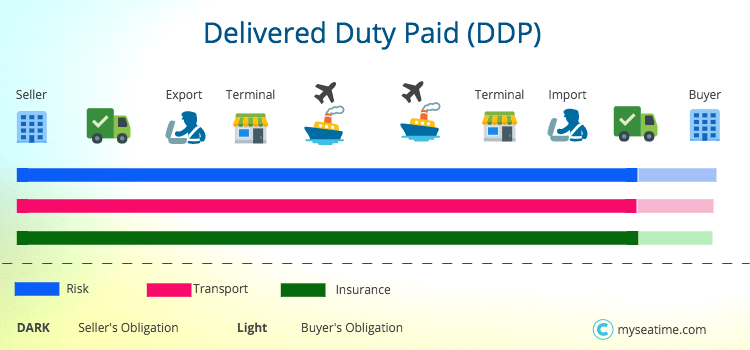
Delivered duty paid is just the opposite of Ex-works. Seller has the most responsibility. Seller has the responsibility to deliver the goods at buyer’s premises, depot or any other place as agreed. It means that from seller’s premises to buyer’s premises or any other agreed place
- The delivery point is buyer’s premises or other place agreed.
- Seller handles the cargo and pays for export as well as import dues and
- Seller arranges the transport of the cargo. Which also means that in case of sea transport, seller will be the shipper of the goods.
- Seller pays for the insurance.
As in Ex-works, DDP can also have practical difficulties in cross border assignments. In DDP, seller is responsible to clear the import formalities but the seller may not have the local knowledge & expertise to clear import formalities.
3. Free Carrier (FCA):
Mode of transport: Multimodal

Free carrier means the delivery point is carrier or other person nominated by the buyer at the seller’s premises or other agreed place. If the agreed place is seller’s premises, delivery takes place when the goods load on the truck. If the agreed place is not seller’s premises then the delivery takes place when truck arrives at this place and is ready for unloading. In Free carrier (FCA),
- The delivery point is seller’s premises or any other place agreed.
- buyer pays for the export from seller’s premises and import into the destination.
- buyer arranges for all modes of transport
In FCA incoterm, the agreed place has implications on the loading of the carrier. If the agreed place is seller’s premises then seller handles the loading. If the agreed place is other than seller’s premises, then seller has delivered the goods once the carrier arrives at the agreed place.
“FCA seller’s premises” might look similar to Ex-works but there is one main difference. In FCA, seller has the obligation to load the goods on the carrier.
4. Free Onboard (FOB):
Mode of transport: Sea
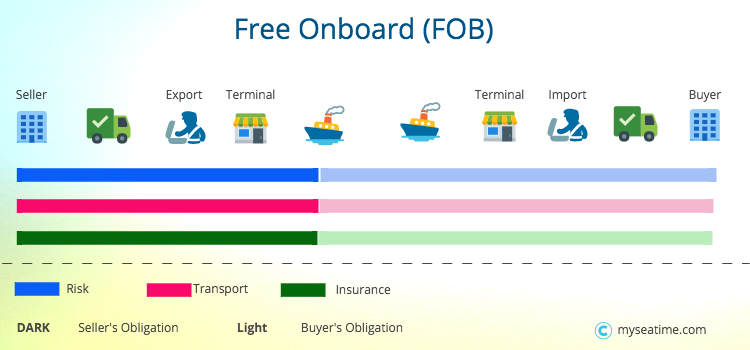
Free onboard means the seller delivers the shipment to the carrier nominated by the buyer. There is only a slight difference between FCA and FOB. One difference is the mode of transport. While FCA is applicable for multimodal transport, FOB is used only for sea transport. In FOB, the seller passes the risk to the buyer when shipment crosses ship’s rail. In FCA, the seller has the obligation to load the shipment on to the carrier arranged by buyer which is prior to the main carrier.
5. Cost and Freight (CFR)
Mode of transport: Sea
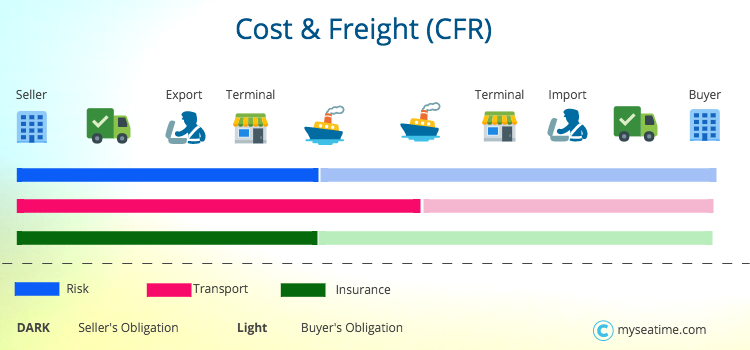
By cost and freight, it means while seller bears cost and freight of shipment to the destination but the risk is with the buyer. And that is also the main difference between CFR and FOB incoterms. In FOB, seller delivers the shipment and passes the risk to buyer when shipment crosses ship’s rail. But, in CFR, he also pays for the costs and freight until the shipment reaches to the destination. This was exactly the point discussed earlier. Arranging for the transport does not mean that the risk is with the party arranging the transport. In this case, seller arranges the main transport (Seller is the shipper), but he has already delivered the shipment or passed the risk to the buyer upon shipment crossing th ship’s rail.
6. Cost , Insurance and Freight (CIF)
Mode of transport: Sea
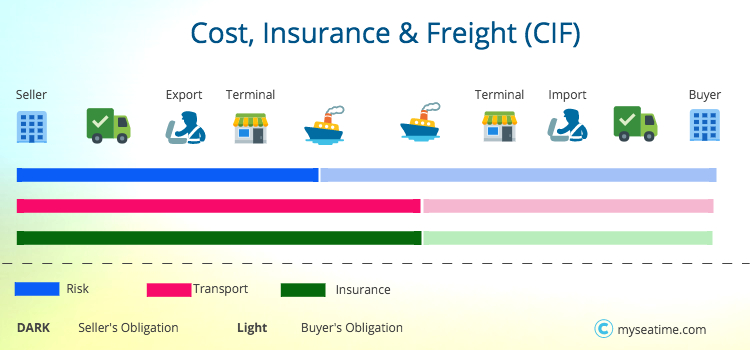
There is only one but obvious difference between CFR and CIF and that is addition of Insurance. Seller passes the risk to the buyer when the shipment is loaded on the carrier. But the seller also arranges for the main carrier (Seller is the shipper). Apart from that seller also pays for the insurance for covering the buyer’s risk during carriage of the shipment. As seller would be paying to cover the buyer’s risk, he would offcourse wish to have least insurance just to cover his obligations. Buyer must take this into account and take extra insurance if he wish to.
7. Free Alongside Ship (FAS)
Mode of transport: Sea
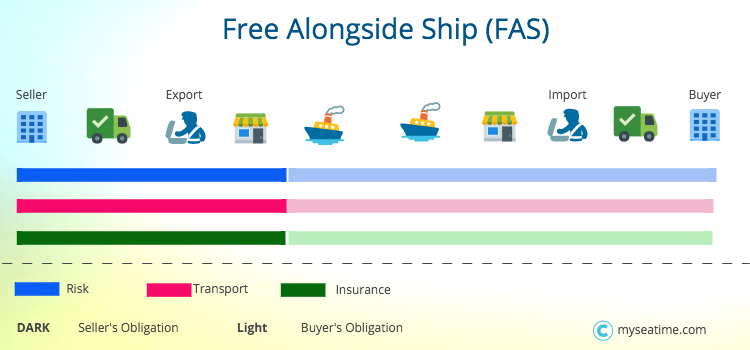
As simple as it sounds. The seller delivers the shipment to buyer when the goods are alongside ship. Risk passes from seller to buyer when the good are brought alongside the ship. Buyer arranges for the main carrier (Buyer is the shipper). Buyer pays for the all the insurance after this point.
8. Carriage paid to (CPT)
Mode of transport: Multimodal
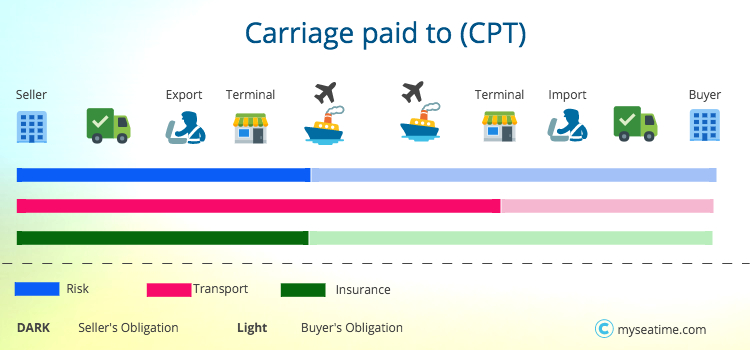
Seller pays for the main carriage to bring the shipment at agreed place. However the seller passes the risk to the buyer upon delivery to the main carrier. This is the point that we highlighted earlier. “Arranging for the main transport does not mean the risk is with the arranging party”. Here even when the seller arranges for the main carrier, risk has already passed to the buyer.
Buyer also arranges for the insurance from the point of delivery.
9. Carriage and insurance paid (CIP)
Mode of transport: Multimodal
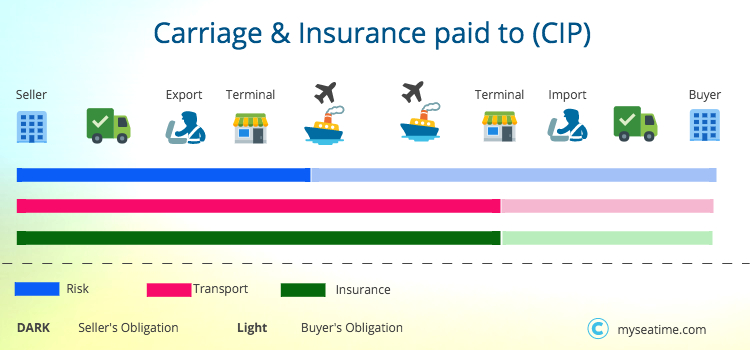
In CIP, Seller delivers the goods and passes the risk to the buyer upon delivery to the main carrier. Seller arranges and pays for the main carrier (Seller is the shipper) to bring the shipment at agreed place. Seller also arranges for insurance on behalf of buyer to cover buyer’s risk. The main difference between CPT and CIP is that the insurance is also paid by the seller. Again this point was highlighted earlier. “arranging for the insurance does not mean that risk is with the party arranging the insurance”. Here Seller pays for the insurance but the risk is not with him. Seller arranges for the insurance to cover buyer’s risk. CIP requires seller to arrange for insurance equals to 110% of the cargo value under minimum insurance claim. Buyer must insure himself against any additional risk he thinks need insuring against.
10. Delivered at place (DAP)
Mode of transport: Multimodal
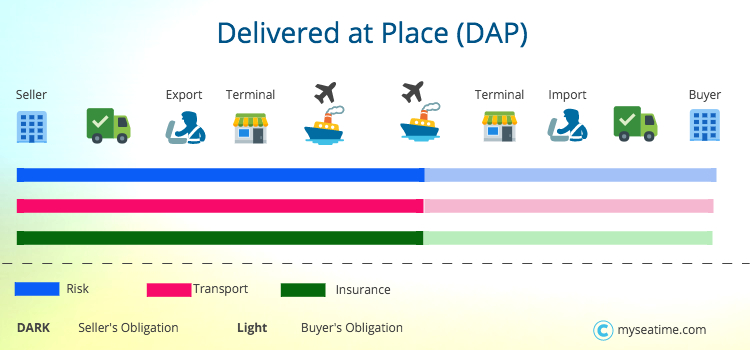
DAP means seller delievers when shipment arrives at final destination, ready for unloading from the arriving mode of transport. Seller bears all the costs and risks in bringing the goods to this place.
1) Seller handles export fees, carriage, insurance and destination port charges.
2) Buyer handles import fees and unloading of goods.
11. Delivered at terminal (DAT)
Mode of transport: Multimodal
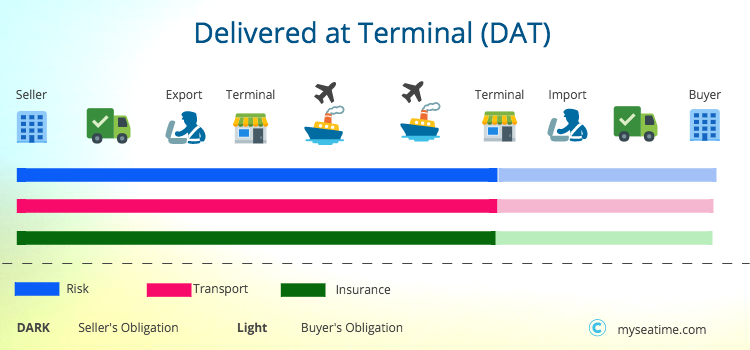
Seller delivers the shipment and passes the risk to the buyer when shipment is put at the disposal of buyer at the terminal of final destination. Seller handles export fees, carriage, insurance, destination port charges and unloading of the goods. The main difference between DAT and DAP is that in DAT, seller handles the final unloading of the goods.
Common Mistakes in using Incoterms
1) Failure to include the precise place alongwith the destination.
The use of Incoterms need to specify the precise place. For example FCA Durban does not specify the precise location as Durban is a broad area. Incoterm must mention the exact location in Durban. For example, FCA Durban berth no 42.
2) Use of DDP incoterm without considering if the seller has the knowledge and expertise or if local regulations allows him to clear import formalities in buyer’s country.
3) Use of EXW incoterm without considering if the buyer has the knowledge and expertise or if local regulations allows him to clear export formalities in seller’s country.
4) Using “sea or inland waterways” incoterms for containerized goods. These four incoterms which are used for sea and inland waterways are not meant for containerized goods. These are actually meant for bulk cargoes and non- containerized goods. Use of these incoterms for containerized goods can put exporters at undue risk as the goods may have to wait several days before despatch.
If you are still in doubt as to which Incoterm you should use where, here is a useful tool you should check. The tool was created by The Belgian foreign trade agency in collaboration with Always consult.